CRUSADERS FOR CHRIST
  • Blog
    • Staff only
  • About Us
  • Downloads
    • Catholic Homeschool - Study Guides
    • Handwriting
    • Student Planners
    • Coloring Pictures
    • St. Catherine's Academy Gazette
    • Printable Children's books
  • Catholic Reading
    • Books We Have Enjoyed
    • Saint of the Day
    • Just Stories
    • Chapter Books >
      • Jesus of Nazareth - The Story of His Life Simply Told
      • Little Therese
      • Lisbeth - The Story of a First Communion
    • Sermons for Children
    • This and That
    • The Blessed Mother for the Child in all of us!
  • For Moms
    • Popular Instructions on the Bringing Up of Children

18th Sunday after Pentecost - The Sin of Blasphemy

9/22/2024

0 Comments

 
 My dear Children: In your catechism you have learned under the Second Commandment what blasphemy means. By blasphemy we mean speaking injuriously of God, or His saints and angels, or sacred things. This is, indeed, a crime which we should expect to find only among the devils in hell. For can it be possible that man, the creature of God, redeemed by the Blood of the Son of God, receiving daily his existence and innumerable benefits from the hand of God, should be capable of speaking injuriously of God, or what immediately relates to Him. And yet, unhappily, it is so.

Many, indeed, blaspheme that which they know not; for example those who, not belonging to our holy religion, and misled by prejudice and false teachers, misrepresent Catholic Doctrine, mock at the ceremonies of the Church, or speak disrespectfully of our Blessed Lady, or the saints, or the holy Sacraments ; but there are others, alas ! Catholics in name, who blaspheme that which they do know, by murmuring against the Justice or Providence of God, jesting about holy things, or mocking at the ministers of the Church.

You can easily understand how heinous this crime is in the sight of God. In the Old Law the blasphemer was, by the command of God Himself, sentenced to death, and stoned in sight of all the people, and in the laws of many Christian nations we find the severest punishments enacted against this crime, as, for example, in the laws of St. Louis, king of France, who ordered the tongue of the blasphemer to be pierced with a red-hot iron. Many instances are likewise recorded, in which God took it upon Himself at once to avenge His own honor, and struck the blasphemer dead in the very act of insulting Him.

Some years ago the town of Nottingham was visited by a most awful thunderstorm, the effects of which were most disastrous. The lower part of the town was flooded, and the poorer classes, who inhabited cellars, as well as many shopkeepers, suffered severely. Among those who sought shelter from the pitiless storm in the Milton's Head public-house, was a young man, a lace-maker by trade. For some time he amused himself with ridiculing the fears of the people, but his language, which was from the first light and unbecoming, became at last impious and profane. He used the Holy Name of God in the most blasphemous manner, and, with bitter oaths, expressed a wish that a thunderbolt might come down and strike his companions blind. Then raising himself, he looked through the skylight over the room in which they were sitting and, with profane gestures, defied the lightning. At that moment a vivid flash entered the room, and in an instant he was lying speechless on the floor. He was taken up by the trembling bystanders, none of whom were injured, and laid upon a couch. The first words he uttered on recovering his speech were: "God forgive me!" He had become blind.

God is blasphemed when we wish Him evil, or when we curse creatures, in so far as they are God's works. He who wishes that there was no God, or that He had not the power to punish the wicked, is guilty of the most horrid blasphemy. He who curses men, cattle, or anything else, such as the weather, is guilty of blasphemy,' according to St. Thomas of Aquin, since these are creatures or works of God; for dishonoring that which God has made is in fact dishonoring God Himself. But God can be blasphemed not only with words, but also with signs and gestures; when a man, for instance, full of rage, raises his clenched hands towards heaven, gnashes his teeth, spits upon holy things, as the soldiers did when they spat upon Jesus,' bent their knees before Him and in derision saluted Him as their king.

Children, this sin can also be committed in thought, when we voluntarily think something of God or His saints which is to their dishonor. Persons who are troubled with involuntary blasphemous thoughts must not allow themselves to be disquieted in their devotion. They should often say "Glory be to the Father, and to the Son, and to the Holy Ghost."

A very holy man left his cell in the desert to visit a sick friend of his youth who dwelt in Alexandria, and who wished to see him before he died. Most of the inhabitants of that city were pagans, who hated the Christian religion. As soon, therefore, as he entered, they knew by his dress that he was a Christian hermit, and began to mock him. Some carried their hatred so far as to strike him, and to abuse him in other ways. But the good man passed on without uttering a word of complaint, and bore all patiently for the love of God. Some of them cried after him in mockery : "Did Jesus Christ ever work a miracle?"

A man who was passing and who was a Christian said: "Yes, Jesus Christ did work many miracles; but even if He had not wrought any, the conduct of this holy man is enough to prove the truth of the Christian religion. What greater miracle could you desire to see? You have insulted and abused the good man because he is a disciple of Jesus Christ, and yet he has borne it all without murmur." These words silenced the people : they were ashamed of what they had done. And some of them, touched by the meekness of the good monk, were led to believe in God and to renounce forever paganism.

Children, by blasphemy God is attacked personally, and His honor violated. One who offends a king personally, commits a greater crime than if he transgresses one of his laws, so the blasphemer commits a far greater sin than some sinner who sins not immediately against God, but only against His law. Now if a man dares to insult and blaspheme God, whom the Cherubim and Seraphim adore with the most profound veneration, must it not be a horrible sin? If a Catholic who is a member of the true Church of God, curses God despite of all graces and evidences of His love, instead of praising and glorifying Him, is it not the most atrocious crime? Very sad to say that even some children, who scarcely know how to make the Sign of the Cross, know how to give themselves to the devil ; they learn how to curse sooner than to pray. Oh, that parents would carefully guard against cursing and blaspheming, so as not to give scandal to their children.

My dear boys and girls, I beg of you avoid the company of blasphemers, they are living devils. Furthermore, consider what you would have to reveal before the throne of God, when you must give an account of every idle word. Let the divine praises be constantly on your lips : "Blessed be God, blessed be His Holy Name."

Source: Story Sermonettes for the Children's Mass, Imprimatur 1921

0 Comments

Easter Sunday - Easter Joys

3/31/2024

1 Comment

 
Picture
My dear Children: Today all Christendom is filled with joy and gladness; and in every land is heard the oft-repeated Alleluia. In all tongues and climes hymns of praise and thanksgiving ascend to the throne of God.

Why this joy? It is on this day the voice of God is heard assuring us that the dead can and will rise again, to enter upon a new and never-dying life. Sometimes a little child dies. That only means that the beautiful angel-like spirit which is in each one of us has left this child's body and flown up to God in heaven. It is bitter for us to lose those we love, but they are happy to go to God. We know that this is true, because after Jesus had died on the cross, after His body had been laid in the grave, His spirit came back to His body, to show us that if we are God's children death is nothing to be afraid of. This is the day Jesus came back to tell His dear friends that they must not be sad because He died.

You have just learned from the gospel how soldiers were placed near the grave to guard it, but the second night, towards morning, when it was beginning to get light, there was a noise and a shaking of the ground, and a beautiful angel came down from heaven and rolled the huge rock back from the cave. The soldiers trembled with fear and ran away.

Among the friends who came to visit Jesus at the tomb was Mary Magdalen. She had loved Jesus with all her heart, for He had been very good to her, making her life, which had been sinful and bad, sweet and good. She came to find the grave empty, and leaving the spot with a heavy heart she turned back. On her way out she met a man in the garden. Her eyes were so full of tears that she could not see plainly, and she supposed that He was the gardener. He asked her: "Why weepest thou ?" She answered:

"Sir, if thou hast borne Him away, tell me where thou hast laid Him?"  Then the man said, in a voice she knew and loved more than any voice on earth, "Mary !" Who do you think it was ? It was Jesus, and when she heard His voice she turned, and knelt at His feet, crying with great joy, "Master!"

So Jesus came to His disciples, to one by one, or two or three together. And at last they all knew that He was really risen from the dead—that He was alive. And they learned, too, what we must learn and never forget, that as Jesus rose from the dead, so we and all those we love rise also. Sometimes when we go to sleep at night it is dark and stormy and we feel tired and fearsome, but when we wake in the morning the sky is blue, the sun is shining and we are cheerful. Dying is very much like this; falling to sleep here, when our course is run, and we are tired after all our trials and tribulations, and waking in heaven with Jesus.

That is why Jesus came back on that Easter morning after He had died on the cross; to show us that death is nothing to be afraid of, for it means going to be with Him.

When the pagans were leading St. Pionius to the place of martydom, they were surprised to see the joy that lighted up his countenance, and how eagerly he ran towards the place of His death.
"What makes you so happy?" they asked him, "and why do you run forward with so much eagerness to death?" "You are mistaken," answered the martyr, "I am not going to death; I am about to begin a life that will never end." This is how the saints spoke of what the world calls death.

However long or sweet may be the pleasure of the draught of life, and health, and prosperity, all finally come to the one bitter drop at the bottom of the cup. And that is death. The Church, the divinely instituted Guardian of God's word, tells us that Christ has conquered death. All who die shall rise again from the dead, because our Saviour Jesus Christ, first of all, rose from the dead, and promised that the change of a similar resurrection should come upon all mankind. Bitter as death may be, the hope of the resurrection is a complete antidote. A "happy death" is a common saying among Catholics. It is a resurrection to eternal life.

In the life of the holy martyr Pamphilius we read that many pagans who saw the great joy that filled the Christians, when they were condemned to die for Jesus Christ, wondered how they could be so happy. And when they were told that it was because they were so soon to see God in heaven and to enjoy the happiness God had prepared for them, they also wished to become Christians, that they might share in that happiness.

They had not long to wait for the martyr's crown. For the Prefect of Cesarea, hearing of what had taken place, sent soldiers to bring them before him. One of the first questions he put to them was: "What country do you belong to ?" "Our country is heaven," was the answer; "it is there where our God and our Saviour dwells. After He had suffered and died, and rose again from the dead, He went up to heaven to prepare a place for us. So heaven is our home."
The Prefect was very angry at the tone of confidence in which they said these words and commanded them to suffer the most inhuman tortures.

Children, many Catholics think so much of the world that they seem to forget that the world is not their proper goal. Judging from the lives of some Christians, a person would not think that they ever think of death.

Many years ago there was a certain lord who kept a fool in his palace, as many great men did for their amusement in those days.

Now, this lord had given the fool a staff and charged him to keep it till he met with one that was a greater fool than himself, bidding him, if he met with such a one, to deliver the staff to him. Not many years after, the lord fell sick, and, indeed, was sick unto death.

The fool came to see him, and the sick master told him that he and hast made no orders for thy comfort in a place from which thou wilt never return? Take my staff, for I am not guilty of any such folly as this."

Children, we will ask ourselves, have I a right to participate in the Easter joy of to-day, or am I only making an outside show, while my conscience tells me I am a hypocrite? What kind of a life would I rise to on the day of resurrection if I died' tonight? What would Jesus Christ find in me that looks like Him, and therefore give me a share in His glorious resurrection ? Dear Children, that is what He wants to find in us all. Let us now rise from all that is deadly or corrupt in the life we are leading, and Jesus will be sure to find in us what will entitle us to a resurrection to eternal happiness.
 
Source: Story Sermonettes for the Children's Mass, Imprimatur 1921


1 Comment

Palm Sunday - Perseverance

3/23/2024

2 Comments

 
Picture
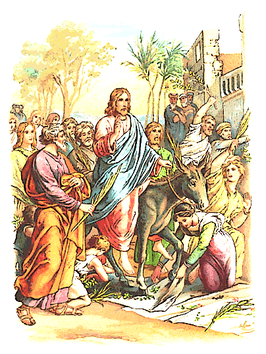
"Hosanna to the Son of David," is the joyful acclamation with which the Jews greeted our Lord to-day as He made His entrance into the royal city. But how quickly that has changed, for within a few days after the same people begin to cry out: "Crucify Him." Who would imagine such inconstancy possible? Sad to say, children, this occurs every day. Just think what have you done, for as often as you commit a mortal sin you have rejected Jesus and crucified Him anew. The glorious Hosanna which arose in your heart at the reception of Holy Communion was by your sinful deeds exchanged for the fearful "Away with Him, crucify Him." You have, indeed, done this, and not like the Jews through blindness, but with the full knowledge that Jesus is your Saviour. You have been shamefully inconstant to Him, who has never injured you, who loved you and died for you. Should not the greatest sorrow penetrate your hearts? Should you not with your whole heart renew your resolution to remain loyal to your Saviour.

A pious mother who had brought up her son with great care, seeing him about to leave her to enter the world, desired to give him a lesson. For two days she gave him nothing to eat but sweet food. At first the young man was pleased with it, thinking that his mother was very kind to him before leaving home. But when the evening of the first day had come, he asked her to give him some solid food. But she told him that he must be content.

The next day when he received the same kind of food, he became so disgusted with it that he could not even look at it, and he asked his mother to give him some plain bread. His mother said to him: "My dear child, I had a special object in placing before you all these dainty dishes. You are about to enter the world that is full of wickedness and ungodliness. It will put before your eyes many pleasing things— glory, honor, riches and pleasures. They simply dazzle the eye. They may be very pleasant for the moment, but they engender remorse. Do not allow yourself to be deceived by them. Yesterday I saw how you loved the sweets I placed before you. Today you are filled with disgust. So it is with those who allow themselves to be deceived by the world. Pleasures soon bring bitterness. Learn a lesson, as soon as you are tempted by these things, thrust them aside and be content with the plain food of the Christian—that is bearing patiently with all your crosses here on earth, that you may obtain an eternal reward in Heaven."
What will it avail us to begin in the grace of God if we do not persevere in it? Not the beginning, but the end of life decides our fate. Judas began well, but how did he end? On the other hand, St. Mary Magdalen and the good thief on the cross persevered in good, that is why they ended as elect children of God.

In a certain college there lived a boy by the name of Paul who was remarkable amongst all the other boys for his gentleness, his piety, and his good conduct; every one loved him. To look at him one would have thought that he had never committed any sin. But such was not the case. There had been a time when that boy, now so gentle, so mild and good, had been a slave to sin. The following is the story of his life and conversion; it was himself who told it to one of his masters: "I was once a good boy; so long as I was near my good mother, and until I was eleven years old, I did not know what mortal sin was. At that time it happened that one day when I was in the fields playing with my companion who was a little older than myself, he taught me to do what was a mortal sin. From that moment I became most unhappy; I could find no peace night nor day, because I knew that if I died in that state I should be sent to hell for all eternity.
"What made my state more awful still was this, that I also went and made two other innocent companions commit a grievous sin. When I came to this college I was quite as bad. I was perfectly miserable, and when I saw others who were so pious and so good I wondered if it. were possible that I could be like them.

"Some of my companions came and asked me to become a member of one of the sodalities of the children of Mary. I joined it just for appearance's sake. It was then for the first time I heard of that little prayer: “O my Queen and my Mother, protect me, help me, for I am thine.' I began to say it every day, and it was not long before I went to confession. I made a good confession; and oh, how happy I felt then.

"But I began to think of the terrible things I did in making the two children commit sin, so I am going to become a brother of that religious community which has specially for its object the pious education of the young, that I may be the means of saving more souls than I may have caused to be lost.

"Temptations often come back to me; but when they come I immediately remember the little aspiration: 'O my Queen and my Mother.' I at once say it, and then the temptation soon goes away."

Take away perseverance and what remains ? All else is vain and useless ; to no purpose all your good works and piety, mortification and mercy, to no purpose so many sufferings endured. Perseverance is the crown of all good, for without it we cannot obtain that which alone is good and desirable. Perseverance is the narrow way through which we must force ourselves at any cost. Perseverance is the pearl of all graces, since those who have obtained it now dwell in the land of peace and happiness.

There was once a rich count called Otho, who had a daughter whom he loved with great affection. One day the child was amusing herself with some beads of glass, with which she seemed to be much pleased. Her father was sitting by the fire watching her. My child," he said, "these are pretty beads you are playing with." Yes, papa, they are very beautiful, and I am delighted with them." Well, then," said the father, "take them up and throw them all into the fire." The child looked up into her father's face to see if he was in earnest. One glance told her he was. "Well, dear child, you may do as you please, but you know that when I ask you to do something, it is always because I, who love you so tenderly, see that it will be best for you." The girl at these words gathered up the beads and threw them into the fire. Her father said nothing, but he seemed much pleased at the ready obedience of his dear little girl.

"Now, my child, you will soon see how your father can reward you for that heroic sacrifice you made to please him. He then drew forth from a little draw a little casket and drew out a beautiful necklace, made of glittering diamonds. "This, my child, is for you. I wanted to see if you loved me more than yourself. Take this then, my dearest little one, and when you wear it, it will remind you that your Father in Heaven will reward you with a reward surpassing all understanding in the world to come, if you obey Him in this life, and sacrifice everything rather than displease Him by breaking His commandments."

The saints have persevered unto the end and what they have done we also with a good will can accomplish. Children, we must faithfully cooperate with the graces which our Lord will abundantly grant us for our salvation. We must fight the good fight, scrupulously avoid the dangers and occasions of sin, be diligent in prayer, in the reception of the sacraments and mindful of our last end.

Source: Story Sermonettes for the Children's Mass, Imprimatur 1921

2 Comments

24th Sunday after Pentecost - Prepare to Face the Judgment

11/10/2021

0 Comments

 
Picture
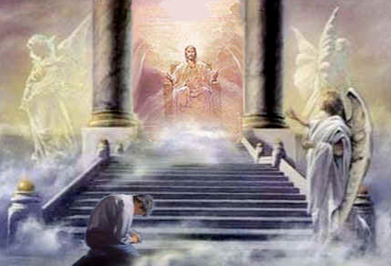
My dear children: As our holy faith teaches us, Jesus Christ will come again at the end of the world to judge the living and the dead. All men that ever lived will rise out of their graves and be gathered together before the Lord of Heaven and earth. God wills all men to be saved, but to a great majority of mankind the sentence of condemnation will be pronounced, as men will not do what is necessary for obtaining salvation. Children, what must we do in order to obtain a favorable judgment? Listen and I shall tell you.

Make a good confession. Many nominal Catholics live for years in entire forgetfulness of God and add sin upon sin. In order to set things right they must make a confession of their past life. There are some who confess invalidly on account of their want of contrition and a firm purpose of amendment; some do not examine their conscience strictly enough, and on that account their confession is very imperfect. Even for those who are pious a rehearsal of their past confessions is at times advisable. In their examination of conscience they might find that one or the other of their past confessions was essentially faulty.

St. John Climacus relates the following consoling story: There lived in the East a young man who had from his youth given himself up to every kind of sin, and was remarkable even among those who were wicked for his evil deeds. But God spoke to the heart of this young man and inspired him with the resolution to return to his Heavenly Father. Going at once to a monastery in Alexandria, he fell down at the feet of the Abbot and besought him to admit him into the number of his religious. The holy man who had heard much about the bad life of this man was indeed glad to see him kneeling so humbly at his feet, but fearing that the present emotions would pass away, he said to him: 'My child, you will
never be able to practice the austerities which our monks practice; besides you would never be able to confess your sins publicly in Church, as is the custom amongst us.' 'Yes, my Father," he answered, "not only would I confess all my sins before the monks of your house, but I am willing to confess them in public before all the world, if necessary.' The abbot on hearing this admitted him.

On the following Sunday, when the monks were assembled in the church to the number of two hundred and thirty, the Abbot ordered the young man to be brought in. He entered clothed in sackcloth and covered with ashes. The Abbot then placed him in the middle of the Church and told him to begin his confession. He at once obeyed and recited his sins amid sobs and tears. During the time he was thus accusing himself one of the monks saw standing at his side a beautiful angel. He held a large open book and with a pen he effaced every sin that was confessed. God was pleased to make known in this way that He forgave that great sinner all that he had done wrong, because he was sorry for his sins, and confessed them.

The same thing happens to you, children, every time you make a good confession. God's angel effaces your sins from the book in which they were recorded, never to appear against you again. Oh, try then, always to make good confessions that your sins may be blotted out, and that your soul may become beautiful before God. If you find it difficult to tell some sin you may have committed, ask the most holy Mother of God to obtain for you the grace to confess it.

When we find that a general confession is necessary we must never delay it. No one knows whether he will be so situated as to make a good general confession. A Spanish nobleman came one day to a missionary, requesting him to hear his general confession. To the question why he wished to make one then he replied : "Ah, must I not die! But if I wait till that time the thought of wife and children, fear, the vehemence of the sickness, may prevent me from being calm and deliberate ; how great, therefore, would be my imprudence if I should put off this business to such an inopportune time and under so many difficulties." And he would not defer his general confession for a single day. Children, do not let a mission, or a jubilee, or a change of your state of life pass by without making a general confession.

Marie, spouse of Louis XV. of France, had a son whom she also trained in the fear of God up from his infancy. When he grew up to be a young man he had to leave his mother's house and live for a time among strangers. During his absence word was brought to his mother that he had to spend part of his time among those who would take a pleasure in corrupting his young heart. As soon as she was informed of this, she threw herself on her knees at the foot of the crucifix and recommended her beloved child to the protection of his Heavenly Father. "O my God," she prayed, "take my darling boy to Thyself, rather than permit him to offend Thee by sin, or to lose the treasure of his innocence."

God heard the prayer of that good mother and delivered him from the evil that threatened him. When he returned home, the first question his mother asked him was if he had much to endure from the companions he had to mingle with. "Yes, my mother," he replied, "great indeed were the dangers they put around me to ruin me; but, thanks be to God, and to your prayers, I have still kept my soul pure and stainless." Not long after this time the young Prince became suddenly very ill and died in sentiments of great piety. On the evening of the day of his death his mother sent for her other children, and, with tears in her eyes, said to them: "Your brother is dead; it is I, your mother, who asked God to take him to Himself. Sometime ago I heard that he was in danger of committing sin. I went on my knees and prayed fervently to God to take him out of this world rather than permit him to lose his innocence. God has heard me, and I thank Him for His goodness to me. Still I weep for him, for I loved him as dearly as any mother could love her child."

Children, you have just heard how prayer kept the son of the king pure and innocent, you can rest assured that his conscience was always in order. How calm and innocent he must have stood before the just Judge. In order to persevere in grace unto the end we need special help from God, for the enemies of our soul are very powerful. We must ask for this help and that is obtained first of all by prayer. Only those obtain salvation who pray, and those are lost who do not pray. All the saints have been saved because they prayed. Who then would not pray with fervor, since so much depends on prayer?

The Sacraments of Penance and the Blessed Eucharist are another means to keep our conscience in order. As often as you make a humble and sincere confession you are cleansed from all your sins, both mortal and venial, and at the same time you also receive special graces by which you are strengthened against sin. Holy Communion affords us extraordinary power and strength to overcome all the assaults of the devil and to persevere in good. Besides these means there is another and that is devotion to the saints of God. By devotion to the saints we can obtain many graces, they are in great favor with God and are His friends. But we may promise to ourselves still greater graces from our devotion to Mary, because she is not only a servant of God, but also the Mother of God. The prayer of Mary, being the prayer of a mother, has the virtue almost of a command.

A young man who had many times fallen into mortal sins went to confession to a certain priest. The good priest in order to encourage his penitent to be good, said : "My child, I will tell you an easy means to overcome temptations. If you do what I tell you, you will never fall again." "Oh, my Father," he replied, "tell me what it is, for with all my heart I desire to overcome all my evil habits." "Say a 'Hail Mary' every morning and evening in honor of her immaculate purity, and whenever you are tempted to do evil, say to her at once, 'O Mary, help me, for I am thine.' " The young man followed this advice, and in a short time was entirely delivered from his bad habits. Now it happened a short time afterwards that he was relating this to some of his acquaintances whom he had formerly scandalized by his bad conduct. Amongst those who were listening to him was a young officer, who, like himself, had fallen into many sins, because he went willfully with bad companions. As soon as he had heard the young man's story he resolved to follow his example. He at once went to confession and continued to lead a pious life. "O Mary, help me, for I am thine," was his watchword whenever any temptation assailed him. Some months after his conversion he had the imprudence to go again to visit those companions who had formerly led him into sin; he wished to see if they had followed his example. But no sooner had he reached the place where they dwelt than a strange feeling of terror came over him, and he cried out : "O Mary, help me, for I am thine." That very instant he felt himself thrust back by an invisible hand and found himself at a distance from the house. He immediately saw the danger in which he had been and returned his most heartfelt thanks to God and His Holy Mother for having thus preserved him.

My dear boys and girls, you know what you must do that you may be prepared to face judgment. You must keep your conscience in order and therefore fervently practice prayer, read pious books, frequently receive the Sacraments and have a great devotion to the Blessed Virgin. Consider that your doom for all eternity will be decided before the judgment seat of God, and therefore let it be your only business to prepare yourselves well for the Day of Judgment.

Source: Story Sermonettes for the Children's Mass, Imprimatur 1921

0 Comments

23rd Sunday after Pentecost - A Very Earnest Thought

10/30/2021

0 Comments

 
Picture
My dear children: A day and an hour will come when we will cease to breathe, our eyes will close, our ears will no longer hear the wailings of our friends, our hands and feet will grow cold, our heart will cease to beat, and our body will lie there motionless, its soul departed, like a castaway garment whose owner will use it no longer. Death is certain to all. And that is why I am speaking of death to you, my dear boys and girls, although you are so young, just starting in to live. From the first breath you drew you have started your march on to death. Since death is certain to all, it is certainly reasonable to think frequently of death that we may prepare ourselves properly for the greatest event of our life.

When you rise in the morning you do not know whether you will be living in the evening. Thousands have risen in the best of health in the morning, and before sunset they were corpses. This was the fate of Abel. Heli, the high priest, and his two sons died suddenly the same day. On the fifteenth of August, 1842, Father Papillon was preaching a sermon in the presence of Prince Polignac and a vast audience in the chapel of the French Embassy in London.

He was in the midst of his sermon, and said: "How precious is time, for we never know at what moment the Almighty will summon us before His tribunal, there to give an account of all our actions." These were the last words he ever uttered. No sooner had he finished this sentence than those who were present noticed his color change; they ran up to the pulpit to help him, but it was too late, the vital spark had fled and the venerable priest was a lifeless corpse. Is it not possible that you may rise in the morning, but when the evening comes you will not lie down, because during the course of the day death will have overtaken you? Since you are not secure one moment against death, is it not right that every morning when you rise you should think of death ?

St. Rose of Lima took a firm resolution to love and to serve God to the end of her life. God sent her many crosses, but she accepted them all with loving resignation to the Divine Will and bore them with heroic patience. She had also much bodily pain to suffer, but this, too, she bore from the hand of God. One day she was suffering more than usual; so great was the pain that she thought it would be impossible for her to endure it much longer. As this thought was passing through her mind she heard a sweet voice which said these words: "My dear child, My Cross was still more painful." These words consoled her and she bore her sufferings patiently to the end. She is now in Heaven enjoying the crown of happiness they gained for her.

Death enters into cities and villages at night and snatches his prey, now here now there. It was in the darkness of the night that the destroying angel came into the houses of the Egyptians and snatched away the first born. It was in the darkness of the night that the heroic Judith cut off the head of the drunken Holofernes.

Experience teaches us that more people die in the night than in the day-time. It is at any rate possible that some of us this night must make that journey on which everything depends. Consider this and never go to bed without a serious thought of death. And when you awake during the night think of your grave and say a "Hail Mary" for a happy death. Think of death in all temptations. Our life upon earth is a continuous struggle, and scarcely a day passes when we are not tempted.

Examples from Holy Scripture can show us the terrible devastations wrought. Cain, who slew his own brother Abel ; David, who loaded his conscience with a double crime; Judas Iscariot, who betrayed his Lord and Master. Whence these crimes? From temptations which were not resisted.

St. Rose of Lima, when a little girl, had very beautiful hair which hung in ringlets over her shoulders. Although she already loved God very much she was not altogether free from vanity which so often enters the hearts even of little children. One day while she was playing with her brother, he accidentally threw a quantity of mud on her hair. At this the child looked at him with a vexed countenance and was on the point of getting angry with him for what he had done to her. When he saw this and knew what was taking place in her heart, he said : "My dear sister, do not be angry at what I have done ; I did not intend to do it. But keep in mind that the devil often makes use of fine curls like these to drag good girls down to hell." Rose at once put away the anger that Had risen in her heart, and from that moment, young as she was, she took the resolution never to allow her heart to be attached to any worldly thing, that she might always persevere in the service of God.

How can we preserve ourselves from sin in all temptations? By thinking of death. How would it be possible to sin if we but said to ourselves : I must die, and I know neither how, when, nor where. This thought had been a shield to thousands, they escaped many temptations. Blessed Thomas More, the Chancellor of England, was in prison; his death on the block was certain unless he would renounce his allegiance to the Catholic Church and accommodate himself to the will of the king. His wife visited him in prison and conjured him with many tears to obey the king. Thomas looked at his wife earnestly and said: "Tell me how long shall I live if I do the will of the king and offend God ?" "O surely twenty years," was the reply. "O foolish woman," he replied, "for the sake of twenty years to die miserably and plunge myself into hell ? No, no; I would rather die than displease God. I would rather die the temporal than the eternal death." Thus spoke the great and good man. Take an example from this heroic champion.

In a hospital for sick soldiers there was a young man lying in danger of death ; he was a Catholic. Several times during his illness the priest asked him to prepare to die well, as there was but little hope of his recovery. "Not yet," he always answered. "Not yet; I will think of it tomorrow." The next day he gave the same answer, but added : "I should like very much to make my confession, but it is impossible for me to do so." "What is there that can make it impossible for you to make your confession, my boy?" said the priest The only answer the dying man gave was : "Don't speak to me of this any more, I beseech you, for I tell you it is impossible." The priest tried to show him the happiness and peace that fill the soul of a sinner who has obtained God's pardon, and asked him for God's sake to make his peace with God. The soldier shook his head. "It is of no use, Father, for you to ask me to do this. Do you see those men there? What would they think or say?" The priest at once saw that it was human respect which made the young man so stubborn, so he went to the group of visiting soldiers and said to them : "Comrades, you are making that young man die an unhappy death." "How, sir, are we doing that?" "He says," answered the priest, "that you would call him a coward and a fool if he went to confession." The men rose up in a body and went over to their dying comrade. "Do you think that we are pagans?" they exclaimed. "Instead of even thinking of calling you a coward we were quite alarmed about your refusal." These words cured the young man. He called the priest and made his confession and died an hour afterwards with a peaceful smile upon his countenance.

Children, we all have to make a long journey and like every good traveler we ought to prepare ourselves for it. And how can we be so forgetful as not to think of this journey? All persons who had the salvation of their soul at heart often thought of death. The Emperor Maximilian had his coffin made years before his death. He kept it in his room, and when he traveled he brought it with him in order by the sight of it to be reminded of death.

You see a funeral procession ; what is more natural than to think: Soon I shall be carried to the grave. You see this one or that one taking sick and dying. Ought you not to think : my turn will soon come. When you hear the clock strike, will you not think of your dying hour and say: Perhaps I shall die at the same hour that has just struck and appear before God. These frequent thoughts of death will be the means for the preservation of a good conscience, and a good conscience is like a continual feast.

My dear boys and girls, walk in the fear of God that you may obtain the greatest, most desirable and necessary of all graces—the grace of a happy death.

Source: Story Sermonettes for the Children's Mass, Imprimatur 1921

0 Comments

21st Sunday after Pentecost - The Blindness of Sinners

10/16/2021

0 Comments

 
My dear Children : A Roman philosopher tells of an old woman who lived in his house but who on account of age had become blind. Yet she called continually upon her servants to take her to some other dwelling, as she could not see in the one she occupied, because, as she thought, all the windows were walled up. Sinners are like this poor woman. They are blind, but will not believe it. There are many who desire to be praised and honored; who are always right and will yield to no one. They are evidently proud, and the worst feature is that they cannot see it; though they go to confession they fail to accuse themselves of the sin of pride. There are others again whose heart is so set on getting money, that they will even deny themselves and others the necessities of life, just to accumulate money. These are misers, totally blind to the passion of avarice. Lastly there is a class of spiritually blind persons who live according to the spirit of the world, never mortifying themselves, but following a code of morals contrary to the spirit of Christianity. To which of these class do you belong? Be not blind, children; compare your actions with the Christian law, and with the example of Christ and the saints.

St. Dominic received from God the grace of converting most obstinate sinners into great saints. One of these was Don Pedro, a nobleman of Aragon. When the saint was preaching in that part of the country, this gentleman, hearing of the wonders he wrought, had a great desire to see him. So he set out one day,accompanied by servants, and entered the church where St. Dominic was going to preach. Not with the intention of changing his life did he go there, but only to satisfy his curiosity. The people who knew of the bad life he was leading were astonished to see him in church. When Don Pedro entered, St. Dominic was kneeling before the altar, and God was pleased to make known to this holy man the dreadful state of the sinner's soul. He seemed to behold entering the church a hideous monster, with eyes starting from his head, and hands like eagle's claws. At this sight the man of God was filled with terror. "O my God, I beseech Thee," he cried out, "change the heart of this great sinner and make him truly penitent." Then going into the pulpit, he preached a sermon upon the awful effects of mortal sin. But all his eloquence was lost on this stubborn sinner. Not many days afterwards the same nobleman returned once more to this church, and St. Dominic was preaching as he came in. Suddenly stopping his sermon, and turning towards the crucifix, he exclaimed: "O Jesus, full of mercy, O Jesus, all-powerful, let Thy people here see with their bodily eyes the sad state of the soul of him who has just entered Thy Holy House." This prayer was heard. In an instant the proud Don Pedro appeared before them as a hideous monster, surrounded by a multitude of evil spirits, who held him by a chain. Terror and fear came upon all the gathered multitude. Some began to scream; in short a great tumult arose in the house of God. Don Pedro was astonished at seeing the dismay his appearance had caused, nor could he understand whence it proceeded. Calling one of his servants who was trembling from head to foot, he asked what it all meant. "My Lord," answered the servant, "is it possible that you alone do not see the terrible change that has come over you? You are surrounded by evil spirits that hold you by a chain."Only then did the unfortunate man realize that God had manifested the state of his soul to those who were present. Thereupon St. Dominic exhorted the people to cease their cries and to pray instead. Calling one of his disciples he gave him his rosary beads, and said : "Give these to Don Pedro and tell him to ask mercy and pardon from God." No sooner had Don Pedro taken the beads into his hands than he assumed his usual appearance. Kneeling down before the altar of the Blessed Mother he was filled with compunction of heart, and amid a flood of tears confessed his sins to St. Dominic and asked pardon of all the people for the scandal he had given them. Ever afterwards his life was one of penance and piety and he died in the odor of sanctity.
 
Like a man asleep sinners have lost their hearing. Conscience, it is true, is ever awake and knocks at the sinner's heart, reproaching him bitterly for his sinful life, but he is perfectly deaf. He drowns the voice of conscience by worldly pleasures and refuses to heed the admonitions of his pastor and friends. There are many daughters who do not regard the warning words of their parents. They persevere in sin, as though this world were never to be destroyed,— as though they had here an eternal resting place ! Oh, that every sinner would be aroused from the sleep of sin!

A certain young man was filled with the deepest melancholy at the death of a young person with whom he had been sinning. Nothing could console him, and very soon his health began to give way. . One of his companions, observing this, and knowing well the cause of it, thought of a cure, severe indeed, but one which he hoped would prove effective; for being pious himself he desired to bring his friend back to the path of virtue. He asked him to accompany him to the cemetery, and going to the grave wherein the remains of the young person had been interred, he opened it, as also the coffin. The stench of the decaying corpse was so unbearable that the young man turned to run away. "Why do you run away?" said the other. "Of what are you afraid? Come and behold the countenance of your friend, the friend with whom you have broken God's commandments—one who weeps in the other life for the momentary pleasures of this wicked world. Come and learn what a sad and bitter thing it is to have forsaken the Lord Thy God."

This lesson, though severe, had the desired effect. The young man repented of his past sins, and lived and died as saints do. You have learned by experience, my children, how sleep deprives you of the use of your senses; in like manner the torpor of sin does not permit you to see the pernicious consequences of a godless life.

There is no greater misfortune than sin; by it you lose the grace of God; you relinquish your rights to the merits you have acquired for heaven; and are in imminent danger of being lost forever. Cooperate then with the grace of God all your life long for that will enable you to see clearly the way to heaven.

Source: Story Sermonettes for the Children's Mass, Imprimatur 1921
0 Comments

20th Sunday after Pentecost - Parental Example

10/10/2021

0 Comments

 
Picture
My dear Children: We know that example draws, be it for good or for evil. At the conclusion of today's Gospel we read that not only the ruler, but also his whole house, believed in Jesus. If the ruler had not believed in Christ, those of his household would not have believed in Him; his whole house, his wife, children, and servants believed in Him.

Children, if you are blessed with good parents who give you a good example there is no better means of training you to become good Catholic men and women. Good example is the best teacher of good morals.

The unbounded confidence which you have in your parents, makes you consider everything they do as right and good. If you see that your parents pray devoutly, diligently visit the church, and if their daily conduct shows that they have the fear of God before their eyes, it will make a salutary impression upon you ; that which is good will take root in the hearts of the children of such parents and will become almost a second nature. And when you, young folks, grow up, when severe and dangerous trials have to be endured, you will have become so confirmed in virtue, that sin will not overcome you. And even if you should fall, you will soon rise; your wounded conscience will give you no rest, but will  urge and impel you to reconcile yourselves with God as soon as possible.

The Prophet Ezechiel speaks of a wagon drawn by four living beings; as these moved along, the wheels of the wagon turned round and followed. By this wagon we can understand a family; the beings that draw the wagon are the parents ; but the wheels are the children. Now, just as the wheels turned around and went the same direction as the beings that drew the wagon, so children act according to the example of their parents. St. Chrysostom says : "The works of the parents are books from which the children learn. The tongue, the lips of the parents, are as so many books, from which children are taught."
 
There lived about the middle of the thirteenth century, in Brittany, a pious married couple. God blessed their union by giving them a son, whom they called Yves, and whom they resolved to bring up in piety and the knowledge of God's holy law. The mother especially watched over him, and ceased not to say to him, over and over again : "Yves, you must be a saint." The child, hearing these words so often, said to her one day: "Mother, what is a saint?" "A saint, my child, is one whom God has made to be forever with Him in heaven. A saint is one who loves God above all things, and His Son Jesus Christ : one who keeps all the commandments of God, that he may be with Jesus Christ in heaven." The child listened to these lessons of his mother with his hands joined, and his eyes fixed on hers, eager for every word she said, andwhen she had ended he would say to her : "My mother, I must be a saint; I will love God with all my heart, and all my lifetime I will try to please Him." His father then would say: "My child, your mother has taught you how to love God, I will teach you now how to love your neighbor for God's sake." And he took his little boy on errands of charity and showed him those outward deeds of virtue that mark the Christian among men, and make him glorify His Father who is in heaven. And thus the child grew up a saint.

We read in the Bible that Tobias led a blameless and holy life in the midst of a godless, vicious city. He did this because he was so fortunate as to have a father who not only instructed him in every virtue, but also gave him a most beautiful example. How was it that Timothy lived so piously that St. Paul states that he had found a disciple who was entirely of his own disposition, and who interested himself in the welfare of the faithful as zealously as himself?

The Apostle traces the source to the disciple's mother and grandmother. What kind of parents have as a rule good children? To whom belong those boys and girls who are distinguished for modesty, obedience, fervor in prayer, and fear of God ? Who are those young men and women, who by their reserve and modesty are models for the entire congregation? They are usually the children of good Catholic parents. Since those young people see and hear nothing at home but what is good, they themselves become good, and justify in their parents the hope that they will always remain so. Yes, the lessons and admonitions of parents sink deeply into the hearts of children. They resemble a gentle rain, which moistens ' the soil and causes a plentiful supply of fruit.

There was once a pious mother who had a son whom she taught to love God. From his earliest years he followed the holy counsels she gave him, and grew up a model to all the young men around him. He went frequently to the Sacraments, and there was every appearance that he would live and die a saint. Things went on in this hopeful way till he had reached his seventeenth year. All at once a change came over him. His piety seemed to melt slowly away, and he no longer went to the Sacraments as he used to do. This change in his conduct was soon observed by his good mother. For a long time she tried very hard to find out what was the cause of this change. He never went with bad companions, and she never saw him read bad books. One day when she was more sorrowful than ever she went to see him in his room. "My dear child," she said to him, "you must tell me what is the cause of the great change that I observe in you ; you are not the same pious boy that you used to be. You must tell me all about it." But the son did not speak. He hung his head, and his face grew crimson with shame. His mother became more and more alarmed, and she pressed him with the most endearing words. "My mother," he began, "since you have asked me in this way, I will not hide anything from you; I will tell you all. I loved my religion dearly and I found my greatest delight in the practice of it. But now I have grown up, and I have begun to reflect. Look at my father; see how the world honors and esteems him. Oh, how much I would like to resemble him ! Yet he does not practice his religion. Surely I cannot do wrong in acting as he does. Now, my dearest mother, I have told you all." The poor afflicted mother left her son, and flew at once to the room where her husband was. She sat down by his side, and in the midst of tears and sobs, told him all that her son had said to her. "Come with me," he said, "I have misled my boy, but I may yet save him." Saying these words he went down to his son's room. "My child," he said, "it is indeed a hard thing for a father to go on his knees to his own son, but I will do it. Yes, my child, I am guilty—guilty of a great sin. I have not lost my faith. It is that cursed human respect that kept me from professing my faith openly. Thanks be to God, it is not too late. Forgive me, my dear child, for the bad example. Who is your confessor, he shall also be mine."

The best person if he has bad example before him is in great danger to lose his good principles. This is very true of children who like to imitate what they see and hear, without knowing the consequences of sin. In their simplicity they think that everything done by their parents is good and lawful. As the youth, so the man. The result is that such children often live and die in sin and perish eternally. As long as David himself was pious, his children were the same. But when the father sinned grievously, the children also departed from the right path, and committed heinous crimes.

My dear boys and girls, thank God from the bottom of your heart if you have good Catholic parent? parents who give you a good example. Oh that every Christian mother would ever remember the great influence her example has upon her children for good or for evil, so that she may forever enforce her instruction by her own good example.

Source: Story Sermonettes for the Children's Mass, Imprimatur 1921

0 Comments

19th Sunday after Pentecost -         Honor Due the Anointed of the Lord

10/3/2021

0 Comments

 
Picture
My dear Children: We honor and revere ambassadors and representatives of kings and potentates of this earth; how much more should we not honor and revere the priest, the representative of the King of kings, namely God. When we consider the exalted office and the sublime power entrusted by Jesus Christ to His ministers upon earth, and especially to His priests and bishops, we are struck with amazement, and cannot fail to be penetrated with the deepest reverence for their sacred office. They are the representatives of Jesus Christ here below; in them He still lives among us, speaking to us through their lips the words of eternal life. Ah, my dear children, with what holy awe and profound reverence should we not regard the office of the priest! What respect, too, should we not show in our conduct towards him ! The lips of the priest have the power to call the Son of God down upon the altar, and to open the gates of heaven to the penitent sinner. His hands are daily sanctified by the touch of the most pure and spotless Body of Jesus, which he holds, and raises aloft, and carries in Communion to the faithful, having a privilege like to that of Mary herself, to whom it was given to carry the divine Infant in her arms.

St. Martin, the illustrious Bishop of Tours, being on a visit, upon an affair of business, at the court of Emperor Maximus, was invited, with the priest who accompanied him, to sit down to dinner at the emperor's table. During the repast a cup of wine was poured out and presented to Maximus, who, wishing to do honor to the bishop, ordered it to be first handed to St. Martin, expecting that, when he had tasted, he would return it to him again. To his surprise, however, and of that of the whole court, St. Martin, after he had drunk, passed the cup to his companion, the priest, as being after him the most exalted person in the assembly. So far from being displeased, Maximus applauded this action of the saint, acknowledging that, in the sight of God, who estimates persons at their true value, the imperial is far inferior to the priestly dignity.

The priest announces to us the messages of God, and interprets His divine commandments. He speaks to us, on the part of God, words of consolation, encouragement, counsel, direction, and also reproof, and he continually pleads for us at the throne of grace by the recital of the canonical hours. Truly the office of the priest is an angelic office, or rather is an office far higher than that of the angels, who are but the ministers of God to do His will ; whereas the priest is not only His minister, but His representative upon earth, and a mediator between Him and His people. Hence St. Francis of Assisi was wont to say : "Were I to meet in the street an angel and a priest, I would first bow in reverence to the priest and afterwards in reverence to the angel." And you also, my dear children, when you respectfully bow to salute the priest, or kneel to receive his blessing, show thereby that the same faith which animated the saints burns within your breasts. For you do so because you see with the eyes of your soul Jesus Christ Himself in the person of His priest, and know and feel that though he may be poor and lowly in the eyes of unbelieving men, his sacred character raises him in dignity and honor far above the kings and mighty of the world.

A certain traveler happened at nightfall to reach a large forest, through which he was obliged to pass to reach his destination. There was a shepherd with his flock, and of him he asked the necessary directions by which he might reach in safety the place to which he was going. "The way which leads to the town you wish to go to," he answered, "is long and dangerous, and it will be very difficult for me to point it out to you, for the forest is crossed by so many paths that it will be almost impossible for you to find the right one. There is, indeed, one high road which is broad and easy to walk on, but it leads to a terrible abyss, into which many incautious travelers have fallen and perished." "What is that terrible abyss of which you speak?" said the stranger. "It is a deep ravine, situated at the other end of this forest. There are many wild beasts, and one of them especially is most ferocious, so that we often find remains of unfortunate people whom it has devoured. I have stationed myself here at the entrance of the forest through charity to any who may happen to enter it from this side, that I may guide them. Follow me therefore if you wish to escape death." Then, carrying in one hand a lantern, he took with the other one his companion's hand and during the remainder of the night they walked together through the forest. When the morning dawned, they had reached without accident the farther end of the wood. It was only then the traveler came to realize the extent of the favor that his guide had conferred upon him.

Children, the traveler of whom I have spoken is yourself; the large forest is the world in which we live. The wild beasts are the enemies of our soul, and the terrible monster which destroyed so many people is Satan himself. The abyss which the stranger escaped is Hell, and the path by which he was led to the end of his journey is the one of piety, charity, justice, and purity. The charitable guide is not only your invisible guardian angel, but in a particular manner it is also the priest, whom God has given you to be your visible guide, to instruct you in the way you should go, and to direct your feet in the paths of His commandments, until you reach your home—the kingdom of God your Father. Listen, therefore, my dear boys and girls, to the words of the priest, who is the representative of Jesus Christ to you, that you may reach your, true home.

We must love our priests. It is they who ever encourage our best endeavors, continually exhort us to virtue and the fear of God, share our joys and woes, daily pray for us, and even long after our death continue to recommend us to the mercy of God in the sacrifice of the Mass and in prayer.

You must pray for your priests. The gratitude which you owe them for the benefits they bestow upon you demands this. The first Christians did this. When St. Peter was in prison, they prayed without intermission for him until God delivered him. We must with a good will give them what is due them. Good conscientious Catholics give their pastors what is due them, according to justice and usage, and all the more cheerfully because they know that they will employ their savings for charitable purposes.

Priests preach the truths of our holy Faith, for they are commissioned and empowered to teach Christian Doctrine in school and church. What they teach and preach is not their own word, but the Word of God, the doctrine of the Catholic Church. Good Catholics receive the teaching of their pastor with a believing heart, for they know that he teaches not his own doctrine, but the doctrine of the Church, which is the pillar and ground of truth.

Guard against violating your duties as Catholic children towards your priests and pastors of your souls. Honor them, because the sacred office they administer is one deserving honor, though as men they may have some faults and frailties. Love them, for they are your greatest benefactors, caring for your souls and conferring many graces on you for your salvation. Rest assured that it will be to you a sweet consolation on your death-bed if you can say to yourself that you have always honored and loved your priests.

Source: Story Sermonettes for the Children's Mass, Imprimatur 1921

0 Comments

17th Sunday after Pentecost - Loving God Above All Things

9/19/2021

1 Comment

 
My dear Children: We must love God. What does this mean? It means that we must love God not only exteriorly, but also interiorly. It not only the mere tribute of our words or external appearance in our prayer that He demands, but our words come must from the very bottom of our hearts. Who are those who love God only with their lips ? Those boys or girls who pray without thinking of what they say. Their heart is with their playmates or their toys. Such children offer an insult to God, and consequently cannot expect any result from their prayer.

Those who do not give their heart to God do not love Him. All those who are in mortal sin do not love God; they love their evil passions; they tell a direct lie to God as often as they say: "My God I love Thee" God is not satisfied with a divided heart; we must not divide our love between Him and His Creatures. To love with the whole heart means to love God alone, and everything besides God for God's sake and in such a manner as He wills.

St. Francs de Sales loved God with his whole heart, for he says of himself: "If I knew that there was in my heart a single fibre not for God, I would tear it out at once." If you have any inordinate love for any person of thing expel it from your heart, forr the heart man is a tabernacle in which God alone should dwell.

I heard a story the other day about a little boy who surely had the love of God in his heart. There is one thing he never forgot namely, to take his offering with him every Sunday to church. He had his envelope for his weekly offering just as his father had and he never would go to church unless he had it with him I happened one day that he had to go to church alone on a Sunday when his father and mother were absent. However, he did not go without his offering. He had it in his little white envelope which he carried in his pocket.  That morning a strange lady sat at the head of the seat in the same pew, and when the time came for the offering to be given she looked in her bag and found that she had no money with her. She didn't seem to be troubled about it, but the little boy was greatly troubled and wondered what she would do when the men would come with the plates to receive the offering and she had none to give. You see he had formed the habit of giving and he enjoyed it, and wondered how anybody could go to church without a gift. Well, he got more troubled and anxious the nearer the ushers came with the collection-plates, and when they came to the seat in front of the one where he was sitting he held out his little white envelope to the strange lady, and said to her: "Here, please, take this and put it in the plate, and I'll get under the seat. I'm small and they won't see me." That boy has formed a habit of giving, and when he grows to be a man it will be part of his life and part of his religion to offer his gifts unto the Lord. I think that every boy, no matter how small, ought to give some of his money—however little it may be—to God.

Charity requires that we always will what God wills, that we make a sacrifice of our will to God, and therefore accept cheerfully all crosses and afflictions from His hand. In this way all pious souls manifest their love of God. When St. Gertrude said the "Our Father," she used to repeat three times the words "Thy will be done." While praying thus one day, our blessed Lord appeared to her, having health in one hand and sickness in the other, and said to her: "Choose, daughter, between health and sickness." Which do you suppose the saint chose? Health, of course. No. Well, then sickness ? No. As she did not know what our Lord thought good to give her, she said : "Lord, not my will but Thine be done." Let us be satisfied with whatever God is pleased to send us, firmly convinced that He will send us what is good for us.

In the year 1623, at the beginning of Lent, the Venerable Agnes of Jesus became very ill. She was at that time only twenty-one years old. The physicians did not seem to understand the nature of the malady, and gave her medicine which, instead of making her better, only made her suffer the more. But Agnes never uttered one word of complaint, the only words she said were the following, which she repeated often every day: "O my God, mayest Thou be blessed a thousand times." When Easter Sunday came, God was pleased to reward the patience with which she had suffered the heavy crosses He had been pleased to send her, by permitting her guardian angel to appear to her. "My child," said the angel, "are you happy in your sufferings?" "Yes," she answered, "because it is the holy Will of God, whom I love with all my heart. My heart and my will are entirely united to Him : let Him dispose of me according to His divine Will." The angel answered: "Continue to love Jesus in this way, and be assured that He will never forsake you."

When we love some one sincerely we often think of him, for where our treasure is there also is our heart. If, therefore, we truly love God, we shall frequently think of Him and raise our heart to Him. St. Aloysius was always occupied with the thought of God and divine things, and, whether alone or in company, whether he worked or rested, he had no room in his heart for anything but God.

To spare his weakened health, his superiors ordered him to turn his thoughts sometimes from God and to divert himself. But it was impossible for him to do so. Hence it is not a good sign that so many of us have our thoughts everywhere except with God; that we rise in the morning and lie down in the evening without thinking of God, that we occupy ourselves the whole day entirely with temporal affairs, without even a passing thought of God, that even when in church we give way to distractions, and that in general we care as little about God as about a stranger. If we feel ourselves guilty we must admit that our love of God resembles a weak spark which is liable every moment to be extinguished.

A father and mother were living with their two children on a desert island in the ocean, on which they had been shipwrecked. Roots and vegetables served them for food; a spring was their drink; and a cavern in the rock their dwelling. Storms and tempests often raged fearfully on the island. The children knew nothing of the vast continent; bread, milk, fruit, and whatever other luxury is obtainable there, were things unknown to them.

There landed one day upon the island four Moors in a small boat. The parents were greatly delighted, and hoped now to be rescued from their sufferings. But the boat was too small to take them all over together to the adjoining land, so the father determined to risk the passage first. The mother and children wept, when he embarked in the frail wooden boat, and the four black men were to take him away. But he said : "Weep not, it is a better land : and you will all follow soon." When the little boat returned, and took away the mother, the children wept still more. But she also said: "Weep not! In the better land we shall all meet again." At last came the boat to take away the two children. It was with fear and trembling that they drew near the land. But how delighted were they when their parents appeared on the shore, offered them their hands, led them into the shade of lofty palm trees, and regaled them with milk and honey. "My dear children," said the father, "our voyage from the desert island to this beautiful country has a higher meaning. We are all destined to make a much longer journey, to a much more beautiful country. The whole earth upon which we dwell resembles an island ; this glorious land is an image for us, although only a faint one, of heaven ; the voyage hither over the stormy sea is death ; that little boat resembles the bier, upon which men in black apparel shall sooner or later carry us forth.

But when the hour strikes for us, for myself, your mother, or you! to leave this world, be not afraid. Death is for pious people, who have loved God, and have done His will, nothing else but a voyage to the Better Land."

Children, whatever you do, do all for the love of God, that you may become richer and richer in merits in this world, and hereafter receive in heaven the reward of all that love God.

Source: Story Sermonettes for the Children's Mass, Imprimatur 1921
1 Comment

16th Sunday after Pentecost - The Sin of Pride

9/11/2021

0 Comments

 
My dear Children: Pride is a sin with which almost all men are more or less infected ; even Christians who otherwise lead a good life, are not entirely free from it. It is also certain that no sin causes so much evil as pride, for it is the origin of all vices, and the ruin of all virtues. Girls and boys sometimes wish to appear more than what they really are. They wear fine clothes, they want everybody to see them, they try to make people believe that they are rich. They assume affected and haughty airs, and make others think that they are very smart. Some talk piously and pray devoutly just for the sake of appearing to be saints, and a stranger would expect them one day to be canonized. The likes of these appear to be better  than they really are; they exalt themselves, and sin by pride. There are many who are greatly displeased when others make no ado about them. They desire more honor than they deserve.

A farmer went out with his little boy, Tobias, into the cornfield, to see if his corn was nearly ripe. "Father," said the boy, "how is it that some stalks bend so low to the earth, but others hold their heads so upright? The latter must surely be very fine ones, and the others, which bow so low before them, must be very inferior." His father plucked a couple of ears : "Look," said he, "at this ear, which bends itself so modestly, it is full of the finest
grains; but this, which holds itself so proudly aloft, is quite barren and empty." A mincing air and haughty tread speak a weak heart and empty head.

The proud man refuses to give God the honor that is due Him. All natural and supernatural goods which we possess are gifts of God. If one ascribes to himself the good which he has, he is unjust towards God, and sins by pride. This kind of pride is very common. People ascribe everything to their own application, to their own skill, and deny to have received anything from God, so that they may not be obliged to give thanks to God. Thus the farmer says : "It is no wonder that I have good crops, I have prepared my ground well. There is no mystery in my prosperity."

The business man says : "I understand my business ; I am a shrewd business man and a good financier." These proud persons do not consider that with all their diligence they could not accomplish the least thing if God withheld His blessing. If any one on account of his good works seeks honor and praise from men, he does God a great injustice ; for God demands that men, whose chief end is to praise and glorify God, should occupy themselves in glorifying Him. Let us therefore guard against seeking our own glory in anything, but rather have God's glory in view in all our actions.

St. Rose of Lima was very beautiful in feature and form. But she looked upon beauty as a dangerous gift, because it easily leads to vanity, and she avoided everything that might attract notice. She even destroyed the delicate color of her skin by rubbing it with a sharp drug. Her beautiful hair she cut off. When misfortune suddenly befell her parents her devotion to them led her to try to think of a means to help out. She planted her garden with flowers, made bouquets, and sent a servant out to sell them on the market-place. The proceeds she gave to her mother. Rose permitted no pride to come to her mind. Therefore she did not hesitate to take service as a maid in the household of a man named Gonsalvus. She worked busily at her task, day and night, without, however, interrupting her communion with God. The poor and the sick of the city she visited diligently, but she scorned to make worldly calls merely for social pleasure. St. Rose had neither pride of mind nor of body. She did not think that she was better nor more virtuous than others; she was not vain of her physical beauty ; when her parents had become poor she did not hesitate to serve as a maid for their sake. And because she was not proud she was active in visiting the poor and the sick of the city. He who is proud does not do that, for with pride goes hardness of heart towards our fellow being. He who is proud makes life unbearable
for himself and for others, and at last comes to a fall.
 
Everything we have is loaned to us by God and we keep it only as long as God wills. God resists the proud. On account of pride Lucifer was cast out of heaven. Pride drove our first parents out of paradise, and plunged the whole human race into the misery of sin. Pride confused the tongues of the workers on the Tower of Babel. Pride brought the plague down on the legions of David.

A certain ruler in the East, whose name was Saladin, lay at the point of death. Seeing his end approaching, he commanded one of the courtiers to ride through the whole city, bearing on the point of his spear the winding-sheet which was being prepared for him, and in which he would soon be wrapped, and at the same time cry with loud voice, saying: "This is all that the great Saladin, the terror of his enemies, the mighty potentate of the East, can take with him to the grave, out of all the riches and treasures he possessed'."

My dear boys and girls, as we brought nothing into this world when we came into it, so also, when we depart out of it, we can take nothing with us. Why then should we be proud? Remember where you are, and sigh. Where is your soul? In a body which is subject to a thousand frailties. Where is your body? Upon an earth upon which the curse of God rests; in a valley of tears from which countless sighs and) groans daily ascend to heaven. How can we be proud ? What can dust be proud of ? Whither does our body go ? Into the grave, where it will moulder and return into its original dust.

The adorable Son of God chose for His mother a poor maiden of Galilee, for His foster-father a poor carpenter, for his palace a stable; He lived thirty years as the reputed son of a carpenter. He who was God became man to teach us that we are but men. The saints served God with fidelity, practiced all virtues, rendered great service to men—and yet they were little in their own eyes, and no vain thought found room in their hearts. Mary, the Mother of God, calls herself the handmaid of the Lord. St. John the Baptist deems himself unworthy to loose the latchet of the shoes of our Saviour. Looking at such examples, should we not banish all pride from our hearts ?

Frequently think of the awful consequences which pride draws after it; consider your lowly state, and keep the example of Jesus and His saints before you eyes, that you may learn of them to be meek and humble of heart.

Source: Story Sermonettes for the Children's Mass, Imprimatur 1921
0 Comments

15th Sunday after Pentecost -        Constant Preparation for the Hour of Death

9/4/2021

0 Comments

 
Picture
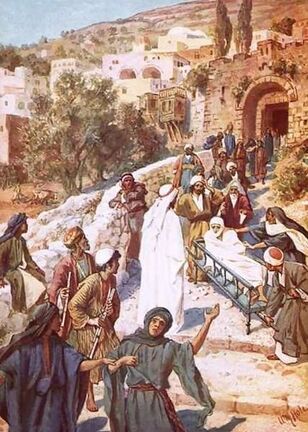
My dear Children: Must I speak to you about death; you who are so young, so hopeful for many years to come? It is, indeed, a sad thought, death. The event related in the gospel of this day is one that has been renewed numberless times, and will be renewed every day as long as there are men upon earth. Where is there a city, a village, or even a house, out of which no dead are carried?

Like the young man of Naim, we, too, shall one day be carried to the cemetery, the last resting place. Nothing is more certain than death; and yet nothing is more uncertain than the hour of death. The history of all times tells us that we do not know when death will come. The first family consisted of four persons, Adam and Eve, Cain and Abel. Who would have believed that Abel, the
youngest member of the family, would die first? The people in Noah's time were eating and drinking when the flood came and took them all away. The daily papers report sudden deaths. We read that some people were killed by burglars and robbers, that one man fell from a scaffold and broke his neck, that many persons drowned, others lost their lives by accidents on railroads or by explosions. Are not persons most dear to us snatched away from our side by sickness, or by accidents ?

What lesson should we draw from this? If you are in the state of grace, you must employ all means to persevere in it unto the end. If you depart from the path of virtue and enter upon the road of sin, death may come suddenly upon you in the midst of your sins.

There was one Stephen, a hermit, who, after he had lived a great part of his life in solitude, fasting, watching, and praying, at last fell sick; and when he was at the point of death, the devil set upon him, and suggested many things to him. Sometimes the hermit cried out: "So it is indeed, I confess I did it; but I have lasted and prayed so many years for it." Other times he cried out : "That is a lie, I did not do it," and again he said : "It is so indeed; but I have shed tears for it; yet notwithstanding," said he, "there is need for mercy."

This example, children, ought to make you wary in all your actions, and flee from sin, and all the occasions of sin, since even this holy man, who had lived nearly forty years a retired and holy life, was so hard pressed by the devil at the hour of his death.

We do not know when death will come; it is active everywhere and knows where to find its victims. It penetrates into all places; no wall, no lock, no bolt can keep it out. People generally die when they least expect it. At the invitation of his brother, the unsuspecting Abel goes out into the field, when Cain suddenly falls upon him and slays him. A man has gallows erected for Mardochai; and a few days afterwards he swings on that very gallows himself. Heli sits down in an armchair to rest himself ; he falls backwards over the chair, and breaks his neck.

Children, we must have God everywhere before our eyes and shun injustice and sin. Avoid all places dangerous to life. Do not commit any foolhardy trick: it is better to be living than dead.

A certain holy priest by the name of Father Arnold saw that his end was near and he received the Sacraments with edifying piety. He asked all those who surrounded his bed to pray for him that he might have a happy death. He had scarcely made this request, when a sudden fear came over him and cold sweat covered his face. "O my brethren," he cried out, "do you not see the evil spirits around me, wanting to carry me to hell ? O, ask Mary, my heavenly Mother, to help me." His friends at once recited the Litany of the Blessed Virgin. When they came to the words, "Holy Mary, pray for him," he cried out, "brethren, say those words again; I am standing at God's judgment-seat." It seemed as if he saw the wicked spirits standing there to accuse him, he seemed to hear accusations, for he said: "Yes, but I did penance for that." He constantly pressed the crucifix to his lips, and continued to whisper the holy name of Mary. On a sudden he exclaimed: "I come, my Lady, I come," and while saying these words he tried to raise himself in his bed, but in doing so he expired.
 
The infinite goodness of God, which sanctifies us on our entrance into the world by Baptism, strengthens and enlightens us by Confirmation, nourishes us with the Holy Eucharist, and heals our spiritual infirmities by Penance, has provided us also with a special Sacrament to assist us in our passage out of this life, and prepare us for a happy eternity. This Sacrament is called Extreme Unction, or the Last Anointing, because in it we are for the last time anointed with Holy Oil. I need not tell you, my dear children, that willfully to omit receiving the Sacrament of Extreme Unction in our last illness, a Sacrament which affords many and such powerful helps towards a good and holy death, would be a sinful neglect and a great ingratitude to God. It would also be wrong willfully to put off receiving this great Sacrament from day to day, when our state has once been declared dangerous ; for we should thereby expose ourselves to the risk of dying without it, or, at least, of receiving it at a time when our strength is so reduced, and our mind so enfeebled, that we could not receive this Sacrament with that spirit of recollection and devout affection which would enable us to reap the full fruit of it. Foolish and ignorant people often imagine that Extreme Unction is like a sentence of death, and that when one has received it, his state may well be despaired) of. On the contrary, there is far more reason to hope for his recovery; for one of the principal effects of this Sacrament is to bless and assist the natural means taken for our bodily cure, whenever God sees this is for our real good.

The virtuous son of Louis XII one day learned that an old servant of his house was in danger of death, and that he would not hear of regulating the affairs of his conscience. He was painfully affected, and thinking that he might do some good in behalf of a man who had spent his life in his service, he went to his house. "Well, my friend," said he, "I am coming to see you, to tell you how sorry I am on your account. I have not forgotten that you always served me with affection ; you would give me, for the first time in your life, the greatest of all sorrows if you did not employ the little while you have yet to live in preparing for death." The poor man was moved to tears by this step of his good master, prepared himself for the Sacraments, and received them with great  piety and devotion.

As for you, my dear children, when serious illness overtakes you, earnestly desire to be purified by the grace of the Sacrament of Extreme Unction. Do your best to secure the same blessing for your father and mother, your relations and friends, and all to whom you may happen to be near in their last moments. How wicked and cruel are those false friends and unnatural children who allow a sick person or parent to approach to the very gate of eternity without the knowledge of their danger, which would enable them to set their affairs in order, and to make their peace with God! By complying with this instruction you will have the happiness of knowing that you have acquitted yourselves of a duty imposed upon you by filial piety, or, at least, by fraternal charity.

As soon as the priest has fixed the day and hour for administering the last Sacraments, you should prepare beforehand a little altar, on which he may place the holy Eucharist and the consecrated oil. Cover a small table with a clean cloth and place thereon a crucifix, two wax candles, some holy water and some common water, and add a few flowers. Meet the priest at the door with a burning candle and escort him to the bedside of the sick person. Kneel down and pray earnestly to God to bless and pardon the sick person.

Be always prepared for death; keep your conscience undefiled; and if you should have the misfortune to fall into sin, make at once a sincere act of contrition and go as soon as you can to confession, in order to reinstate yourself in the state of grace. Pray every day to God for the blessing of a happy death.

Source: Story Sermonettes for the Children's Mass, Imprimatur 1921
0 Comments

14th Sunday after Pentecost - God and Mammon

8/29/2021

0 Comments

 
Picture
My dear Children: Our Lord tells us in the Gospel of this Sunday that we cannot serve two masters. God and Mammon are two masters always at war with each other. Mammon means nothing else than riches or avarice, the inordinate desire after the goods of this world, and a sinful desire to obtain them.

The avaricious man does not seek first the kingdom of God and His justice; what he seeks and desires is money and goods; he thinks only of them. He violates Christian charity and justice; he oppresses the poor, widows and orphans when there is a question of gratifying his avarice.

Children, understand me, to be rich and to be avaricious are not one and the same thing. Abraham, Isaac, Jacob, Job and David were rich, but not avaricious. They were holy men. There are rich people who are not avaricious, and there are poor people who are very avaricious. Only those who inordinately seek and love money and other worldly goods are avaricious.

A merchant named William made a long journey into a distant country, acquired a large fortune by his industry and skill, and after many years returned to his native country. Just as the ship arrived, he heard that all his relations were assembled at a merry supper party in a near-by country house. He immediately hurried to it, and, in the joy of his heart, did not even take time to exchange for a better coat his traveling dress, which had grown rather shabby in the course of the voyage. The consequence was that, as he came into the brilliantly-lighted room, his fine cousins showed but little pleasure at seeing him back again, imagining from his shabby apparel that he had returned home poor. A young servant whom he had brought with him was indignant at the conduct of these relations. "What a heartless set!" said he, "who do not even give their friend a hearty welcome after so long an absence/' "Just wait a moment," said the merchant to him, in a low voice; "they will soon show a different countenance."

He then put a precious ring, which he carried with him, on his finger; and, lo! all their countenances brightened up, and each pressed towards "dear Cousin William." One took him by the hand, another embraced him, and all contended for the honor of receiving and entertaining him at their houses. "Can it then be," said the astonished servant, "that the ring has some hidden power to bewitch the people?" "Oh, no," said William, "it is only that they see by the sparkling ring, which is worth some thousand dollars, that I am rich; and riches rank above everything else in their eyes." "Oh! you blinded men!" cried the boy; "it is not, then, the ring, but your own avarice, that has bewitched you! Can it, indeed, be that men should prize a bit of yellow ore and a brilliant stone more highly than a man so noble as my master?" How many a silly fool worships wealth and is blind to virtue!

We must always be on our guard, dear children, against the hateful and contemptible vice of avarice, which is the fruitful source of so many evils, and we should be the more watchful because it is apt to grow upon people without their perceiving it, especially as they acquire wealth and advance in years. Your parents, dear children, should take every opportunity of promoting liberality in you, teaching you to be generous to your companions, and to love above all things Christ's poor ; otherwise your parents will see you grow up mean, selfish and miserly. You should always remember the words of our divine Lord that He has promised on His own divine word, that even a cup of water given in His name shall not lose its reward.

We have a terrible example of the fatal consequences of 'avarice in the traitor Judas, who, for the few paltry pieces of silver, betrayed His divine Master. On the other hand, it was the charity of Tobias which obtained for him the visit of the archangel Raphael and many blessings, both spiritual and temporal.

Again, it was the hospitality which the woman of Sunam showed to the prophet Eliseus that merited the restoration of her son to life.
 
A rich miser, who had never given a penny to a poor man, kept a monkey for his amusement; but this monkey he even hoped to sell again for more than he had cost. One day this hardhearted man had gone out. The ape got his paws upon the well-filled money chests, and threw whole handfuls of gold and silver out of the window into the street. The people who saw this ran to pick the money up; they scrambled and fought for it and gathered up as much as they could. At length, when the chests were almost empty, the miser came up the street and saw with horror what was going on. "Oh! you hideous, stupid brute!" he cried out, threatening the ape with his clenched fist. A neighbor, however, said to him in the midst of his fury : "Keep your temper. It is certainly stupid to throw money out of the window like this monkey; but, pray, is the man more reasonable who locks it up in chests and makes no use whatever of it ? See how God punished the avaricious man by the means of a stupid animal!

Children, there is a great difference between a proper and an inordinate love of money. He who properly loves money has not the money itself in mind, but the proper use of it; he would be quite indifferent to it if he could not make use of it. Money is to him what medicine is to a sick man. He loves medicine because thereby he hopes to gain a benefit. On the contrary, he who loves money for money's sake, has only the money and not the use of it in view; the possession of money gives him great pleasure.

Thus the rich merchant, of whom Caesarius relates that his friends were obliged to promise him that they would bind a purse of gold upon his heart and put it into the grave with him, certainly loved money. Thus the Emperor Caligula loved money; he often rolled himself on it with great satisfaction. Many Catholics have indeed no purse bound upon their heart, nor do they roll themselves upon their money, but their hearts and souls cling to it; their most pleasant hours are spent in counting their money. The rich man may lose all his wealth by misfortune, and be reduced to beggary during his lifetime; but death tears from man all he possesses. Suppose a man has boxes full of gold, death will not leave him a cent; suppose he owns houses and lands, nothing remains for him but the coffin, in which his body is laid, and a few feet of clay in which he moulders.

The Emperor Constantine one day demonstrated this truth to one of his officers, to cure him of his inordinate love of money. He marked out with his sword on the surface of the ground a space six feet long and two feet wide, and then said to him: "This is all that finally remains for us, my friend ; why should we labor so much to gather riches ?"

Children, often think of this story when you have a desire for the riches and pleasures of the world. 'That is all that will remain to me in death." Remember, man is made for heaven, his eyes look towards heaven. Give a horse a bundle of hay, and a dog a piece of meat, and they are satisfied and wish for no more. The heart of man is made for love and union with God and will never find rest in sensual enjoyments. In spite of his millions the heart of the avaricious man feels disquieted.

A miser had hidden with care a large sum of money in the hollow of a rock. A father of a family, in despair at the want of his children, betook himself to that spot, with the intention of hanging himself with a rope he carried for that purpose. Of a sudden he felt the ground yielding beneath him, and he fell into the hollow which the miser had dug out. After recovering from his fall, he found the treasure hidden there, and took it off as a present from heaven. Later on the miser came to contemplate his gold; finding it gone, he hanged himself with the rope the other had left behind him.

My dear boys and girls, as Christians and followers of Jesus Christ, we must consider that when He came down from heaven upon earth that He would not possess any riches, which you so greedily desire; nay, He loved poverty so much that He chose to be born of a poor and lowly virgin, and not of a rich princess of the earth. When He came into the world He would not live in a magnificent palace, but in a miserable manger where rough straw touched His tender body. Moderate your desires for earthly goods which are vain and frail. Your divine Judge will ask you what you have done for heaven, not what you possessed of the goods of this world. Endeavor to be rich in virtues and good works; these are true treasures, far more precious than all the gold and silver of the world.

Source: Story Sermonettes for the Children's Mass, Imprimatur 1921

0 Comments

13th Sunday after Pentecost - A Healing of Sinful Man

8/21/2021

0 Comments

 
Picture
 My dear Children: If you see among your companions a boy or a girl afflicted with a bad eruption on the skin, you try to avoid them. The Gospel story we have just read, tells of lepers who were looked upon as unclean. The disease they had was called leprosy. Leprosy is a symbol of sin, for as this disease defiles the body, so sin contaminates the soul, deprives it of the life of grace, and plunges it into eternal death. If we wish to be freed of the leprosy of the soul, we must show ourselves to the priests, i. e., we must sincerely confess our sins to them, for they have the power, not only of pronouncing us clean, but of really cleansing us from sins.

We should confess frequently, because we often sin. If there were a man who never in his life committed even a venial sin, he could not and should not confess, for confession is only ordained for sinners. But there is no man or woman who does not some time or other commit sin during the course of life; even the greatest saints were not without some sin, and although they did not sin grievously, yet they were not free from lesser faults. As every man is a sinner, every man must confess, because Christ has ordained it so. Whether we commit mortal or venial sins, we should frequently go to confession.

A hermit having fallen through human frailty into several faults, went to Siloe, one of the great Fathers of the desert, to ask him what he should do. "My son," he answered, "you must rise again from your fall." "But, my Father, I have already done so, and I have fallen again." "Well, just rise again once more." "And how often must I thus rise again?" "As often as you fall," replied the Father. "Rise again always as long as you live, and when the hour of your death comes, it will find you either standing or lying down, and it will carry you in that position before the sovereign tribunal of God."

May God grant, my children, that, when that terrible messenger comes to you, he will find you standing, that is, in the grace of God, so that your sentence then may be that of the just. Though he who lives in the state of grievous sin may perform all kinds of good works, pray, fast, and give alms, yet he cannot expect the least reward for it hereafter. What an injury do not sinners inflict upon themselves who for a long time, often for years, neglect to confess! Even venial sins are a great evil; and if we view them as an offense against God we must look upon them as the greatest of temporal evils. Venial sins prevent our entrance into heaven, and unless forgiven here, they must be atoned for in purgatory. The greater the number of venial sins, the longer will be the punishment in purgatory. Should we not, then, confess frequently in order to free ourselves more and more from venial sins, and not be compelled to suffer long in purgatory? Those who disregard venial sins commit them without fear or scruple. He who does not confess often, easily falls into a state of lukewarmness, and runs the risk of finally falling into mortal sins, and of being ultimately rejected.

A young boy, who had made his First Communion only a few months previously, was sent by his parents as an apprentice to a trade they had chosen for him. On the day of his First Communion he had taken one great resolution, which at all hazards he was resolved to keep. It was this: "If by some great misfortune I should happen to fall into mortal sin, I will go to Confession before I retire to rest on that very same day." This misfortune did occur. It was on a Saturday, and the weather was exceedingly stormy; moreover, the priest lived at a considerable distance from the place where the boy dwelt. The tempter, who had been the occasion of his fall, suggested to him that he might easily delay his visit to the priest for a few days, considering he dwelt at such a distance and the weather was so bad. But suddenly recalling to mind his promise, the boy seemed to hear deep down in his soul a voice—perhaps it might have been that of his guardian angel—which urged him to go immediately: "Go to Confession at once; do as you promised."
 
For a moment he hesitated. Falling down on his knees, he said a "Hail Mary," to obtain the grace of knowing the will of God, and of following it. He rose from his knees and set out for the church. On his return he met his godmother, who inquired of him where he had been. He told her all, with joy on his countenance. "I could not go to sleep," he said, "until I had become reconciled to God." His mother was accustomed on Sunday mornings to allow her children a longer time for sleep than on other days. When it became rather late on this Sunday, she went to the door of the little room in which he slept to awake him. She knocked, but received no answer. She then opened the door, and found him still in bed, asleep, as she thought. "Rise quickly, you lazy boy," she said, as she approached the bed. Seeing that he heeded not, she took his hands; they were cold. With terror she looked more closely at him. This look told her all. The child was dead and his body cold. How fortunate for him that he had not delayed going to Confession. Children, learn from this example never to delay even for one instant the return to God when by misfortune a mortal sin has separated you from Him. Make immediately an act of contrition, and go to Confession as soon as possible.

Most persons immediately after Confession have an earnest desire to sin no more, to avoid all evil occasions, and to lead a new life. For some time everything goes well; they carefully
avoid everything that might cause them to fall, and diligently employ the means prescribed by the confessor. But their fervor gradually lessens; they cease to pray fervently, to not renew their resolutions so frequently; they incline again more to the world. Thus it goes on for some time. Gradually the impressions of grace begin to wane and the fear of God grows weaker and gradually they commit the old sins again. Why this relapse? Because they deferred confession too long; temptation got the upper hand of them.

Children, if you wish to be a good Catholic, and you want to be sure of heaven, you must confess not only once a year, but often. In general, I advise young people to go to Confession once a month. I am convinced that if you confess and communicate often you will preserve yourself from sin, make progress in virtue, and attain salvation.

Source: Story Sermonettes for the Children's Mass, Imprimatur 1921

0 Comments

17th Sunday after Pentecost - Loving God Above all Things

8/15/2021

0 Comments

 
Picture
My dear Children: We must love God. What does this mean?
It means that we must love God not only exteriorly, but also interiorly. It not only the mere tribute of our words or external appearance in our prayer that He demands, but our words come must from the very bottom of our hearts. Who are those who love God only with their lips ? Those boys or girls who pray without thinking of what they say. Their heart is with their playmates or their toys. Such children offer an insult to God, and consequently cannot expect any result from their prayer.   Those who do not give their heart to God do not love Him. All those who are in mortal sin do not love God; they love their evil passions; they tell a direct he to God as often as they say: "My God I love Thee." God is not satisfied with a divided heart; we must not divide our love between Him and His creatures. To love God with the whole heart means to love God alone, and everything besides God for God's sake and in such a manner as He wills.
St. Francs de Sales loved God with his whole heart, for he savs of himself: "If I knew that there was in my heart a single fibre not for God, I would tear it out at once." If you have any inordinate love for any person or thing expel it from your heart, for the heart man is a tabernacle in which God alone should dwell.

I heard a story the other day about a little boy who surely had the love of God in his heart. There is one thing he never forgot namely, to take his offering with him every Sunday to church. He had his envelope for his weekly offering just as his father had and he never would go to church unless he had it with him I happened one day that he had to go to church alone on a Sunday when his father and mother were absent. However, he did Z without his offering. He had it in his little white envelope which he carried in his pocket.  That morning a strange lady sat at the head of the seat m the same pew, and when the time came for the offering to be given she looked in her bag and found that she had no money with her. She didn't seem to be troubled about it, but the little boy was greatly troubled and wondered what she would do when the men would come with the plates to receive the offering and she had none to give. You see he had formed the habit of giving and he enjoyed it, and wondered how anybody could go to church without a gift. Well, he got more troubled and anxious the nearer the ushers came with the collection-plates, and
when they came to the seat in front of the one where he was sitting he held out his little white envelope to the strange lady, and said to her: "Here, please, take this and put it in the plate, and I'll get under the seat. I'm small and they won't see me." That boy has formed a habit of giving, and when he grows to be a man it will be part of his life and part of his religion to offer his gifts unto the Lord. I think that every boy, no matter how small, ought to give some of his money—however little it may be—to God.

Charity requires that we always will what God wills, that we make a sacrifice of our will to God, and therefore accept cheerfully all crosses and afflictions from His hand. In this way all pious souls manifest their love of God. When St. Gertrude said the "Our Father," she used to repeat three times the words "Thy will be done." While praying thus one day, our blessed Lord appeared to her, having health in one hand and sickness in the other, and said to her: "Choose, daughter, between health and sickness." Which do you suppose the saint chose? Health, of course. No. Well, then sickness ? No. As she did not know what our Lord thought good to give her, she said : "Lord, not my will but Thine be done." Let us be satisfied with whatever God is pleased to send us, firmly convinced that He will send us what is good for us.

In the year 1623, at the beginning of Lent, the Venerable Agnes of Jesus became very ill. She was at that time only twenty-one years old. The physicians did not seem to understand the nature of the malady, and gave her medicine which, instead of making her better, only made her suffer the more. But Agnes never uttered one word of complaint, the only words she said were the following, which she repeated often every day: "O my God, mayest Thou be blessed a thousand times." When Easter Sunday came, God was pleased to reward the patience with which she had suffered the heavy crosses He had been pleased to send her, by permitting her guardian angel to appear to her. "My child," said the angel, "are you happy in your sufferings?" "Yes," she answered, "because it is the holy Will of God, whom I love with all my heart. My heart and my will are entirely united to Him: let Him dispose of me according to His divine Will." The angel answered: "Continue to love Jesus in this way, and be assured that He will never forsake you."

When we love some one sincerely we often think of him, for where our treasure is there also is our heart. If, therefore, we truly love God, we shall frequently think of Him and raise our heart to Him. St. Aloysius was always occupied with the thought of God and divine things, and, whether alone or in company, whether he worked or rested, he had no room in his heart for anything but God.

To spare his weakened health, his superiors ordered him to turn his thoughts sometimes from God and to divert himself. But it was impossible for him to do so. Hence it is not a good sign that so many of us have our thoughts everywhere except with God; that we rise in the morning and lie down in the evening without thinking of God, that we occupy ourselves the whole day entirely with temporal affairs, without even a passing thought of God, that even when in church we give way to distractions, and that in general we care as little about God as about a stranger. If we feel ourselves guilty we must admit that our love of God resembles a weak spark which is liable every moment to be extinguished.

A father and mother were living with their two children on a desert island in the ocean, on which they had been shipwrecked. Roots and vegetables served them for food; a spring was their drink; and a cavern in the rock their dwelling. Storms and tempests often raged fearfully on the island. The children knew nothing of the vast continent; bread, milk, fruit, and whatever other luxury is obtainable there, were things unknown to them. There landed one day upon the island four Moors in a small boat. The parents were greatly delighted, and hoped now to be rescued from their sufferings. But the boat was too small to take them all over together to the adjoining land, so the father determined to risk the passage first. The mother and children wept, when he embarked in the frail wooden boat, and the four black men were to take him away. But he said : "Weep not, it is a better land : and you will all follow soon." When the little boat returned, and took away the mother, the children wept still more. But she also said: "Weep not! In the better land we shall all meet again." At last came the boat to take away the two children. It was with fear and trembling that they drew near the land. But how delighted were they when their parents appeared on the shore, offered them their hands, led them into the shade of lofty palm trees, and regaled them with milk and honey. "My dear children," said the father, "our voyage from the desert island to this beautiful country has a higher meaning. We are all destined to make a much longer journey, to a much more beautiful country. The whole earth upon which we dwell resembles an island ; this glorious land is an image for us, although only a faint one, of heaven ; the voyage hither over the stormy sea is death; that little boat resembles the bier, upon which men in black apparel shall sooner or later carry us forth. But when the hour strikes for us, for myself, your mother, or you! to leave this world, be not afraid. Death is for pious people, who have loved God, and have done His will, nothing else but a voyage to the Better Land."

Children, whatever you do, do all for the love of God, that you may become richer and richer in merits in this world, and hereafter receive in heaven the reward of all that love God.

Source: Story Sermonettes for the Children's Mass, Imprimatur 1921

0 Comments

12th Sunday after Pentecost - Heroic Love

8/15/2021

0 Comments

 
Picture
My dear Children: In His public life Jesus taught us to forgive our enemies. He is surrounded on all sides by enemies who envy, hate and persecute Him. They call His miracles the works of the devil, they misrepresent His doctrine, and say that He seduces the people; they pursue Him and strive to take His life. How does He conduct Himself towards them? Does He return evil for evil? No; He suffers and forgives.

In His Passion again Jesus taught us to forgive our enemies. He is apprehended and bound as a malefactor deserving death; He is dragged with contumely and abuse from judge to judge; He is scourged; the soldiers put a crown of thorns on His head and spit in His face; He is crucified between two thieves and is mocked and blasphemed even in the agony of death. He silently and patiently endures it all, and when dying opens His mouth, not to complain, but to pray for His enemies and murderers. After knowing this can we refuse to forgive our enemies ?

During the persecution of Maximinian, St. Sabinus, Bishop of Aris, was tortured at the command of the governor Venustianus. His two hand had been cut off, when the cruel governor was seized with a terrible pain in his eyes and suffered horribly. The holy martyr went over to him and began to pray over him. He had scarcely finished his prayer when the governor was released of his pain. Count Francis of Guise, who waged war against the Protestants, was told that one of them was in the camp seeking to kill him. He had him arrested. The Protestant admitted his purpose. The Count asked him: "Have I done you any harm?" "No," he replied, "but I intended to kill you because you are the greatest enemy of my faith." The Count said: "If you wish to kill me on account of your faith I will forgive you on account of mine," and he dismissed him without punishment, permitting him to pass unmolested out of the camp. To bear wrongs patiently and to forgive injuries, are part of the duty of every Christian. Indeed, it is the very spirit of the Christian religion to suffer patiently the injuries we receive from others, and to forgive our enemies from our hearts. "I say to you," said our Lord, "not to resist evil, but if a man strike thee on the right cheek, turn to him the other also." My dear boys and girls, by bearing patiently the evil which others do us, we prevent their further sin, inasmuch as we soothe their angry feeling, nay, often our very meekness will bring them to repentance; whereas, if we fly into a passion and reproach them, we increase their anger and are the cause of their offending God still more. "A mild word breaketh wrath," says the Wise Man, "but a harsh word stirreth up fury."

A certain official attached to the Court of the Emperor of China became afflicted with a loathsome disease. He was driven from the palace, and, having no friends, was on the point of perishing from exposure and want. Two poor Christians took compassion on him and received him into their cottage, dressed his sores, and waited on him with the greatest tenderness. At the end of three months they ventured to speak to him about the affairs of his soul. To their grief and astonishment he flew into a passion, loaded them with reproaches, and threatened to denounce them to the persecutors. In fact, he left their house and did not return for some time, leaving them for a whole month in fear and trembling. At the end of that time he again had recourse to them for assistance. Forgetting the ingratitude and ill-treatment they had received from him, they welcomed him with the
same charity, and waited on him with the same care, redoubling, in the meanwhile, their prayers for his conversion; whereupon the heart of the pagan was softened. "A religion," said he, "which inspires such conduct cannot but come from God. Teach me to know and love the God whom you serve, and to prepare myself for death which cannot be far distant." The Christians instructed him and had him baptized. Not long after, he expired, glorifying God and blessing his charitable benefactors.
 
It is a universally acknowledged truth: The more difficult the work the greater the reward. The love of friends causes no inconvenience; it is in our nature; but to love an enemy we must do violence to ourselves and overcome ourselves ; it demands some effort on our part. But does not heaven demand efforts? and does it not deserve every effort to gain it? Now, because the love of enemies demands greater efforts, hard struggles, and great self-denial, it has a claim to a great reward.

The great war has brought to light some very striking examples of heroic love. We were told by the daily papers that the Germans hate the English, that the English hate the Turks, and the Turks hate the Italians, and the Italians hate the Austrians, and the Austrians hate the Russians. Everybody hated the other one, for war teaches men to hate their enemies. Jesus, however, taught us to love our enemies. Jesus loved Judas. He prayed for the men who crucified Him. If people would only practice the teaching of Christ there would be no more war.

One of the New York dailies told the story of an Englishman and a German, who had both been severely wounded in one of the battles in Northern France. They lay very near together in the trench. One of them had some water in his canteen, and the other had none, so the one who had the water crawled over and shared it with the suffering enemy. And then they began to love each other, and when they loved each other they could not be enemies any longer.

If you had a little garden, what would you do with it? You would plant flower or vegetable seeds there, and raise something that would be pretty and useful. You would not plant in that garden the seeds of weeds and poisonous plants that would be useless and hurtful. In the same way Jesus tells us that in the garden of the heart we must be sure to plant only good seeds, seeds of love and kindness. We must not allow a single plant of hate to grow there, even hate for our enemies.

Children, if you live in enmity with any of your companions, give it up this very moment, forgive your enemy from your heart, and at the first opportunity extend to him the hand of reconciliation. Be at peace with every one. Forgive one another, that God may forgive you your sins and receive you as His children into the mansions of everlasting peace.

Source: Story Sermonettes for the Children's Mass, Imprimatur 1921

0 Comments

11th Sunday after Pentecost - Unprofitable Speech

8/7/2021

0 Comments

 
. My dear Children : There was one saint once who said : "I wish I had buttons on my lips, which I should have to unfasten before I could speak, for I should then gain more time to reflect and to consider my speech." And that saint is called Francis. He surely did not have need for such buttons, for he was prudent in all things, but we need them in order that that, what is said of the deaf and dumb man in the gospel of this day, may be applied to us: he spoke right. Many sins are committed with the eyes, ears, feet and hands, and with the other senses and members of the body in general; but most sins are committed with the tongue. On the day of judgment we shall see how great is the number of people who on account of sins of the tongue are cast into hell.

Among the Japanese there are certain men called story-tellers. They stand on street corners and a group of children are listening to what he has to say. It happened that one day a Jesuit missionary was passing and he stood and listened, and this is what he heard.
Once upon a time a little boy went to heaven, and the first thing he saw was a long shelf with very strange articles upon it. "What is that," he asked, "is that something to make soup of?" The Japanese are very fond of soup, and the boy thought that the strange things he saw might be used for that purpose. "No," was the reply, "these are the ears of little boys and girls who didn't pay any attention to what they heard, and when they died their ears came to heaven, but the rest of their bodies did not." The little boy saw another shelf with things that were strange and queer to him, and asked what it was. "Those things are tongues," he was told, "they belonged to boys and girls who were always talking and telling other people how to be good, but they themselves never did as they told others to do, and when they died their tongues came to heaven, but the rest of their bodies did not."

Now you know what that story means. It is just a fairy story but like all fairy stories it has a lesson. God gives us ears and tongues and hands and feet and eyes and hearts, to help us if
used rightly, and if we don't use them as God wants us to use them, they do us no good, but evil. Jesus said it would be better for us to be blind than to see only bad things, and that it would be better for us to be deaf than for us to hear only wicked things.

Among your companions you will find boys and girls who always want to speak of their knowledge and cleverness, and when they have done something good they cannot rest until they have published it everywhere. Such discourses are objectionable for two reasons: First, they offend against humility; secondly, they deprive our good works of all merit before God. "Let another praise thee, and not thy own mouth; a stranger, and not thy own lips," so says Holy Writ.

During the cruel persecution of the Chinese Emperor, Hien Fong, A.D. 1850, a Christian convert named Yin came to settle down at the pagan town Lo, where he began to work at his trade, which was that of a tile-maker. He had not received much instruction, and, though fervent and pious, was by no means clever; accordingly he made no attempt to announce the gospel to his new neighbors. Being, however, a man of simple manner, and of a pure, innocent, and upright life, he preached much by his example.

He heard those around him cursing and swearing, but he never cursed. He saw them quarreling and fighting, but he was never seen in a passion or in enmity with his neighbors.

A course of life so different from that of his neighbors excited the curiosity of some gardeners who lived near him. To satisfy themselves they came to visit him. "How is it," they said, "that you do not live as we do? You are not like us; what sort of a man are you?" "I am a Christian," he replied, "and I do nothing but follow the teaching of my religion." "Your religion!" said they; "what is your religion and what is its teaching?" Explanations followed, and his religion was thought to be good because he himself was good. In a short time eighteen pagans became Christians.
 
Unprofitable speech is found in whispering and tale-bearing, which consists in telling a person the evil things another has said about him and thus sowing the seeds of dissension and discord. A tale-bearer frequently causes those who have loved one another and lived in peace to become bitter enemies. The tale-bearer pretends to be well-disposed towards his fellow men; he does not let it appear that he means any harm; by a friendly manner he endeavors to gain confidence; in the meantime, he lies in wait, like the sneak he is, watching all their movements and words, and then reports them, exaggerated and distorted, to the person or the persons whom he wishes to prejudice against them.

Children, tale-bearing is an abominable vice in the eyes of God; therefore the Sacred Scripture says: "Six things there are which the Lord hateth, and the seventh His soul detesteth: haughty eyes, a lying tongue, hands that shed innocent blood, a heart that deviseth wicked plots, feet that are swift to run into mischief, a deceitful witness that uttereth lies, and him that soweth discord among brethren." Boys and girls, guard against this vice, and be faithful to secrets entrusted to you.

One day an English nobleman came to see John Wedgwood, the famous potter. You know a potter is a man who makes beautiful things out of clay. One of the employees, a lad of fifteen years, was delegated to show the nobleman around the factory. Now this nobleman was a man who didn't believe in God, and who, while he was learned, yet was very rough in his speech and used bad words and made light of sacred things. The boy was at first greatly shocked at the nobleman's wicked words, but after a while laughed at his smart remarks. Mr. Wedgwood, who followed them, heard much of the conversation and was very indignant at the way in which the nobleman spoke before the boy. When they came back to the office, Mr. Wedgwood picked out a very beautiful vase of the choicest pattern, and holding it in his hands, told the nobleman the long and careful way in which it had been prepared. The nobleman was greatly pleased with the explanation and was much charmed with the beautiful shape and color and design of the vase, and reached out his hand to take it.

Just as he touched it, however, the owner let it fall to the ground, and his visitor, uttering an angry word, said : "I wanted that one for myself, and now it is ruined by your carelessness." "My lord," said the old potter, "there are things more precious than any vase—things which when ruined can never be restored. I can make another vase like this for you, but you can never give back to the boy who has just left us the simple faith and the pure heart which you have destroyed by making light of sacred things and by using impure words in his presence." I have heard men say that they would give their right arm if they could forget some of the things they heard when they were boys.

Children, be prudent in your speech, and always reflect, before you open your mouth, whether what you are going to say is right and according to the will of God. Be moderate in speaking; the less you speak the less you sin, and the more easily you can give an account of your words. If you observe this one rule, you will not contaminate your conscience with any sinful word.

 Source: Story Sermonettes for the Children's Mass, Imprimatur 1921


0 Comments

10th Sunday after Pentecost -          The Foundation Stone of Every Virtue

7/30/2021

0 Comments

 
Picture
 My dear Children: A great contrast is seen in the picture the Gospel puts before our eyes today. There are two men, the one very proud and haughty, the other humble. Children, which of the two would you prefer? You will say, "I like the Publican, for he is humble." Our Divine Lord prefers him also. Humility is the foundation of all justice: without it no one can please God, though he may practice and possess all virtues. Why did the fallen angels become devils? Simply because they failed to be humble. As soon as they listened to the suggestions of pride, God withdrew His grace from them and they were expelled from happiness into eternal misery.

How low a man can fall when he leaves the narrow path of humility, we see in a certain Justin, a Franciscan friar and companion of St. John Capistran. He had received extraordinary graces by means of prayer, vigilance, mortification and other pious practices, so that far and near he was venerated as a pattern of Christian perfection and as a man highly favored by God. Even Pope Eugene IV., having received very favorable accounts of him, and being anxious to become personally acquainted with him, invited him to come to Rome. When he was introduced the Pope rose from his seat, went to meet him, embraced him and made the friar sit beside him. On Justin's return St. John Capistran looked at him sorrowfully, and said: "O brother Justin, you went away an angel; you come back a devil." Events confirmed only too plainly the truth of this harsh language. Justin seemed to grow prouder from day to day; for the most trivial reason he loudly complained that he was not treated with becoming respect; finally he forgot himself so far as to thrust a knife into the breast of one of the brothers, by whom, as he thought, he had been treated with contempt. After this murder he fled, and wandered about committing many other crimes. At last he was cast into prison at Naples, and, hardened in unbelief and malice, he put an end to his life. If he had remained humble he might now be a saint in heaven.

Among all the virtues of our Blessed Lord, there are three especially which we ought to strive continually to learn of Him, namely, Meekness, Humility, and Obedience. And why so? First, because He Himself points them out especially for our imitation, and, secondly, because they are all three opposed to the deadly sin of pride, which was the beginning of evil, and the cause of the fall of both the angels and our first parents. Pride, the mother of many other vices, shows itself especially in three ways, namely, by resenting injuries, attributing all good to itself, and setting itself up against lawful authority. Now the three virtues before mentioned are directly opposed to these three forms of pride.

Meekness enables us to bear injuries and affronts without resentment; Humility makes us acknowledge by deeds, as well as words, that whatever good we have comes from God; and Obedience makes us submit our will to that of our superiors for the love of God. Hence if we practice these three virtues, we shall heal three of the worst wounds inflicted on our souls by pride, and we shall have gone a great way towards making our souls conformable to the image of Jesus Christ.

General Howard was a great soldier of the Civil War, he was not only brave but just and kind, and every one who knew him loved him. During General Sherman's last campaign in the South he had been put at the head of a special division. A great parade was to take place in the city of Washington at the close of the war, and the officer whose place General Howard had taken insisted on riding at the head of the division, and his friends were so powerful that General Sherman could not refuse the request. He sent for General Howard, told him of the request and asked him if he would mind to let the other General ride at the head of the division. General Howard replied that the division was now his command and he had the right to ride at its head. "Of course, that is true" said General Sherman, "but, Howard, you are a Christian, and don't care so much about show, and your brilliant record can stand this disappointment.,, "Oh," said General Howard, "if that's what you mean, let him ride there and let him have the honor." "Very well," said General Sherman, "let him have the honor, but you will report to me before the start of the parade and ride by my side at the head of the whole army."

So you see that by giving up what he had a right to claim, this general gained a much greater honor. Jesus tells us a great many things about humility and about seeking the first place. And He tells us that the man who is last may be the first, and the man who is least may be greatest, and that the man who is willing to be a servant is, after all, a king.

Of Meekness and Humility, our Blessed Lord says to us in the Holy Gospel, "Learn of me, because I am meek and humble of heart." These three are, therefore, the favorite virtues of the Sacred Heart of Jesus; and if you wish to know to what extent our Lord practiced them, you have only to read the history of His cruel Passion. There you will see Him betrayed, blasphemed, mocked, derided, blindfolded, struck on the face, spit upon, scourged, crowned with thorns and crucified, yet uttering not a word of complaint, on the contrary, praying for His executioners.

All the exercises of virtue and of good works are valueless before God without humility. This is strikingly shown in the following legend. A certain saint had a vision. He was placed at the judgment-seat of God, and saw how every moment souls, who had departed this life, arrived to be judged. Each had a sack over his shoulder ; in the front part were his good works, and in the part hanging behind were his sins. Both the good works and the sins, after their kind, were put up in packages. The sack in each case was opened and the packages with their good works and sins were laid upon the scales. The packages of the sins of most people by far outweighed the packages of good works, whereupon the divine Judge pronounced sentence of condemnation. Finally a woman came with a sack, the front part of which was full of good works while the other part contained only a few faults. The saint thought: "Thanks be to God, this woman will certainly go to heaven.' But when the good works were put into the scales they were as light as a feather and were overbalanced by the sins. Full of astonishment the saint asked an angel who was standing by : "How is it that this multitude of good works has so light a weight?" The angel replied: "Know that this woman has done a great deal of good, but since she was full of vanity and pride, her good works are without weight in the eyes of the all-seeing Judge, and she is lost forever."

My dear boys and girls, learn from what you have heard, how necessary a virtue humility is for our salvation. Without it, there is no forgiveness of sin, no good work meritorious for heaven, and no final perseverance.

Source: Story Sermonettes for the Children's Mass, Imprimatur 1921


0 Comments

8th Sunday after Pentecost - Judgment

7/17/2021

0 Comments

 
Picture
My dear Children : "Give an account of thy stewardship." With these words we shall be greeted when we leave this world and appear before Jesus Christ in the world to come. What will we have
to say when we have to stand before One who knows even our most
secret thoughts? No wonder that the saints lived so piously, no wonder that they mortified themselves continuously. Many saints, like Gregory the Great, Lidwina, Teresa, were afflicted with bodily
infirmities all their lives and they bore them patiently. St. Aloysius,
St. Stanislaus Kostka, St. Agnes, St. Cecilia began already from an early age to prepare for the last hour of their lives.

Towards the middle of the fifteenth century a young man went to the gate of a Carthusian monastery not far from Gand, and asked to be admitted as a monk. His name was Peter of Dume. The superior received him with great kindness, and after the usual probation gave him the habit of the Order. He persevered in his vocation till his happy death, which took place in the year 1490.

During all the many years he spent in that monastery he was never seen to smile, and an unwonted earnestness accompanied every one of his actions. It was a long time before the superior discovered the cause of this; but, being commanded to make it known to him, the monk in virtue of obedience, related to him the reason of it in these words: "I was passing through that part of the country which is watered by the deep river Escaut, and in crossing over it I fell into the water, and sank to the bottom. I felt that I was drowning, and that in a few moments I should be in eternity. I at once was seized with great fear as I thought of the terrible judgment of God which  I was soon to undergo, especially as I was thus called out of life so suddenly without time to make any preparation. I thought of Mary my Mother in Heaven, and I prayed to her. 'O Mary, Our Lady of Good Help, come to my assistance,'" I said to her. My prayer was not in vain. At that same moment I felt myself lifted from the bottom of the river and laid upon the bank. I fell upon my knees to thank God. Then I took the resolution to spend the rest of my life in preparing myself for a happy death, and on that very day I came to this house, that I might immediately begin to fulfill my resolution. I also at the same time resolved to spend the remainder of my days in the service of Mary, to show my gratitude to her for her maternal protection, and for having saved me from certain death." The holy religious was little known by men, for it was his continual prayer that he should live unknown to the world.

Sometimes, children, you will hear the Church speak of the first and second coming of the Son of God. His first coming was when He came into the world as a little babe, and was born in the stable at Bethlehem. His coming then was in the midst of poverty, suffering and neglect. But His second coming which will be at the end of the world, to judge mankind, will be in power, majesty, and glory. Our Blessed Lord, therefore, will come to judge us all at the end of the world, but He will also judge each of us at the moment of our death. On the day of general judgment the justice of God will be made manifest to everyone. It often happens in this life that the good are poor, persecuted and despised, while the wicked are rich, prosperous, and held in honor and esteem by the world. Thus if we looked no further than the present life, it might seem to some, who do not bear in mind that the peace of a good conscience and the happiness of a virtuous life are far beyond all worldly advantages, as if the wicked rather than the good, are the favorites of Heaven. It will then be seen that the short sufferings of this life, borne with patience for the love of God, have secured for the good an eternity of happiness; while the false pleasures and sinful enjoyments of the wicked are the cause of their eternal damnation.

Aripart, King of the Lombards, when dissatisfaction broke out in his army, wished to flee into France. He could not bear the thought, however, to leave his treasures behind and therefore took as much gold as he could carry, and fled at night. He was obliged to swim the river Tessino, but the great quantity of gold which he carried frustrated all his exertions, the weight of the precious metal dragged him to the bottom, and he met his death in the water. Thus he who lets his heart cling to gold and the temporal goods in this world, is drawn into the abyss of hell.

My dear boys and girls, after your soul has left your body it must appear before Jesus Christ. Christ will be its judge, for to Him the Father has committed the judgment. Christ has been to the soul until its departure a God of love and mercy, and has bestowed on it countless graces. But now He stands before it in another character; now He is its judge, who regards not the person of man, who demands an account of every idle word, who has the power and the will to condemn the impenitent sinner. When Joseph in Egypt made himself known to his brothers and said: "I am Joseph whom you sold," his brothers could not answer him, being struck with exceeding great fear. I leave it to yourselves to judge what anguish and terror must seize the guilty soul when on a sudden it sees itself placed in the presence of an angry judge. "That moment," says St. Basil, "will be to it more painful than all the pains of hell."

Ask yourselves : Do I love God above all things, and do I show it by this, that I would rather suffer all evils, even death, than offend God by a mortal sin ? Do I raise my heart frequently to God ? Do I love to pray? Do I frequently receive the sacraments? Do I mean well by everybody? Do I rejoice at my neighbor's success; have I patience with his failings ; do I love to do him acts of kindness? These are the questions we ought to put to ourselves every day so that we might prepare to meet our Judge.

In the court-house of Lubeck is a famous painting, called the dance of death. There you see all classes of ages, children, youth, virgins, men and women, the aged, all dancing, rejoicing and exulting in full pleasure of life, and they do not perceive that the angel of death, with the scythe, walks behind them, to mow down one after the other, to lead them to his realm. Here drops as his victim a child, there an aged man, here a youth, and nevertheless the dance continues in mad enjoyment. Thus it is in the life of man. Daily we see the angel of death walking softly in our midst, demanding his victims, and we know not how, when or where he will call us. All we do know is, that he will not forget us, and behind him is the divine Judge and the momentous eternity, and nevertheless we live in blindness and frivolity, as if our stay here on earth were everlasting.

Let no day pass, children, without heartily repenting of your faults and endeavor to expiate them by various works of penance. If in such a way you judge yourselves, you will not be judged. Jesus will graciously receive you on the day of judgment and greet you as His dear child.

Source: Story Sermonettes for the Children's Mass, Imprimatur 1921

0 Comments

7th Sunday after Pentecost - Bad Associations

7/10/2021

0 Comments

 
Picture
 My dear Children: Whatever our company is, such are we. That is what our divine Lord wants to teach us today. Is it possible to associate every day with an outcast, without becoming accustomed to his faults, learning to love them by degrees and then firmly become a reprobate oneself ? Among a hundred sound apples place one that is decayed ; will this one again become fresh, or will it bring corruption to all the good ones? Place one diseased sheep among a flock of healthy ones, will the sick sheep become well, or will the whole flock become infected? See how nature teaches us by most impressive examples, what will be our portion in the spiritual life if we do not heed the words of Jesus Christ.

One Lucifer sufficed to transform millions of good and holy angels into devils, one immoral child is able to infect a whole school, and to poison the hearts of all the children.I cannot, my dear children, impress upon you too strongly the necessity of avoiding all evil companions. Alas, how many are now in hell who owe their eternal damnation to the bad advice or wicked example of some false friend, whom they now curse as the author of their ruin. Our Blessed Lord, to show us the absolute necessity of avoiding all bad company and, indeed, every occasion of sin, however near and dear it may be to us, says: "If thy hand or thy foot scandalize thee, cut it off and cast it from thee. It is better for thee to go into life maimed or lame, than having two hands or two feet to be cast into everlasting fire."

Learn from these words of our Lord to make any sacrifice, however much it may cost you, to keep out of bad company and the occasion of sin. If you have a friend or a companion, who is as dear to you as your eye, or your foot, or your hand, but who is, or who is likely to be, an occasion of sin to you, shun him as you would the devil himself. It is better for you to go without him to eternal life, than to be condemned along with him to everlasting torments.

My dear boys and girls, as you value your eternal salvation meditate on this example, for what happened to this young man might also happen to you. In a certain town in France there lived not long ago a young man who was an example and a model of piety to everyone. One day in the neighborhood there was held a public demonstration, on account of some local festival. This young man was anxious, like those of his age, to go and join the rejoicings. On ordinary occasions he was accompanied by a companion of his own age, pious and innocent as himself, but on this day this companion remained at home, probably on account of his fear of being led into occasions of sins. So the youth went thither alone.

On the way he was overtaken by another young man, who was notorious for his depravity. Our young man's duty was to avoid this new comrade, lest he might be led by him into temptation, but this he neglected to do. At first their conversation was about matters of little importance, but little by little his new companion began to utter unbecoming words, and to speak in contempt of religious things. The young man neglected to pray to God for
help, and to turn away from the path of evil, and in a short time lost the grace of God.

Not long afterwards he who had been so innocent and so pure was killed by an accident. Thus by a sudden and unprovided death, he was called before the dread tribunal of Jesus Christ, to be judged and condemned. The young man who had been the occasion of his fall was so overcome with this sudden end that he at once went to the neighboring monastery, and, casting himself at the feet of the Abbot, besought him to receive him, that he might do penance for his great sin.

"O my Father," he said, "I beseech thee to have pity on one who has just been the cause of casting into hell a soul created by God for heaven. Permit me to do penance under your guidance for the rest of my life." He became a fervent religious, but was thereafter never seen to smile; in his humility and sorrow he would cast himself on the ground before the religious as they entered the church.

Evil example is as catching as fever or small-pox; and a sin committed in the presence of others, especially of children and young people, is but too often the occasion of their falling into a like offense at some future temptation. Hence, it follows that the greater the number of those who hear or see us do wrong, the more grievous does our sin become, as by one sin we may be the cause of the ruin of many souls. For this reason, when we go to confession we ought to mention, as nearly as we can, the number of those to whom we have given bad example.

An Arab, living alone in his tent, one day was surprised to hear footsteps coming straight for the door of his tent. He was soon more surprised than ever to see the folds of the tent door open and the nose of a camel come through. "Out with you," said the Arab, but the camel didn't move, but said : "It's so cold out here. Please let me put only my nose through the door so that I may be warmed just a little." "Well, see that you come in no farther," said the Arab, and having said that he went about his work. When he turned to look again, the camel's entire head was in at the door, and it was looking all over the tent. "Didn't I tell you to come no farther?" said the Arab. "My head was cold," said the camel, "and I thought if you would let my nose in you would not mind about my head." "Well, see that you come no farther," said the Arab, and again went about his work. When he looked again, the camel had put its front foot and shoulder through the door and was reaching farther into the tent. The man turned quickly and was angry and told the camel to move back and go away, and was about to reach down and lift up a stick to strike it, when the camel walked boldly into the tent and drove the man forth from his own home.

I think you know now what it means when people say, "Beware of the camel's nose." There is only one way to keep the camel out, and that is not to let even its nose in, and there is only one way to keep evil out of our thoughts and minds and hearts and that is not to allow it to have the least entrance.

As to wicked company, I must again remind you that there is no danger against which we ought to be more constantly on our guard. There would be very few sins committed in this world, very few souls lost eternally, if it were not for the bad advice and evil example of wicked companions. The devil is not permitted to come to tempt you in visible form as he came to Adam and Eve, so he does what is far more likely to succeed, he sends bad companions to draw you into sin by means of their example.

Children, in choosing our friends we should select those from whom we can learn something good, and whose virtue and piety may be a bright example before our eyes to encourage us to overcome our faults, and advance daily in the way of perfection.


0 Comments

6th Sunday after Pentecost - Intemperance

7/3/2021

0 Comments

 
Picture
 My dear Children: Saint Matthew today tells us all about the big banquet, probably the greatest banquet ever given; four thousand men sat down to it including women and children. But great as the banquet was, and numerous as the guests were, there were none who ate more than sufficient to sustain life.

The sin of intemperance is an inordinate desire for food and drink. There are some people who never stop eating; they resemble a mill that never stops; their life is a continual round of eating. Those who eat outside of meal times eat merely for the gratification of the palate. Every one must conceive that such continual eating or drinking is sinful, especially for a Christian, who is to imitate the mortification of the Lord and Master in all things.

The glutton, or the drunkard, is like a beast of the field, a slave to his own appetites, for he is led by them rather than by reason, or the Law of God. The consequence is that his mind becomes darkened, his will corrupted, and his heart hardened against divine grace. Of the terrible fruit of drunkenness I need hardly speak.

Everywhere you see homes made desolate, wives and children starving and naked, the most horrible crimes committed, and sinners brought to a miserable and untimely end through this accursed sin.

Ah, my dear children, pray earnestly to God that you never be so unhappy as to become victims to this vice and, in order that you may be preserved from the danger of it, practice throughout life continual temperance, or moderation in your eating and drinking. Deny yourselves now in little things, and you will acquire that command over yourselves which, with God's grace, will enable you to stand firm in after life against greater temptations.

St. Monica, the mother of the great St. Augustine, was brought up under the care of a virtuous woman, who endeavored to train her in the habits of self-denial as well as other virtues. Thus, among other excellent practices, she would never allow the little Monica to drink between meals, saying to her, "Now you only want a drink of water; but when you grow up and are mistress of the cellar, you will not care for water, though the habit of drinking will still remain." The very danger which the prudent servant had foreseen actually befell her, for as she grew older her parents frequently entrusted her with the key of the cellar, and sent her to draw wine for the use of the family. When so doing she would sometimes, out of curiosity, take a little sip, but by degrees the quantity increased, and she acquired at length such a liking for wine that she would drink whole cupfuls with the greatest relish.

Thus did she sow the seeds of intemperance, and by indulgence expose herself to the danger of grievous excess. Almighty God saw her peril, and mercifully rescued her from the brink of the precipice in the following manner:

It happened one day that the young Monica had some angry words with one of the servants. Now this was the very maid who had been in the habit of accompanying her young mistress to the cellar, and who had frequently noticed her fondness for the wine cup. In her vexation she now reproached St. Monica with her failing, calling her a young wine-bibber. The expression made the deepest impression on her mistress, who, entering into herself, sincerely deplored her fault, and from the moment entirely corrected it. Thus did her humility in profiting by the rebuke of a servant lay the foundation of her future sanctity.

Intemperance is the source of many sins, the first is the neglect of religious duties. This is particularly true of drunkards. They omit private and family devotions; they neglect to hear Mass on Sundays and Holydays. They are deadly enemies of the word of God; they scarcely ever listen to a sermon, but ridicule it. They neglect to go to confession during the year; and they let many an Easter pass without complying with their Easter duty.

One morning Johnny went to town with his father, and stayed in his office until it was time to go to lunch. Johnny had never remained downtown so long, and he was very much interested in all the books and papers and drawers and desks in his father's great office. He and his father were chums, and when lunch-time came they went off together to eat at a near-by restaurant. The waiter knew the boy's father and when he received the order for lunch asked the boy what he would like to have to drink. The waiter did not ask his father, because he knew that it was the father's custom to have a bottle of wine each day. The boy replied as he had to the other questions: "I'll take what father takes." Then his father knew that something must be done, that it would never do for the waiter to bring a bottle of wine to the boy, and so he quietly called the waiter to his side and changed his order and asked for a glass of milk. And so when lunch was brought in, two glasses of milk were set down on the table, one for the boy and one for his father and the little lad was greatly pleased that both of them should be having the same lunch; but all that afternoon after the father had gone back to his office the words of Johnny kept ringing in his ears: "I'll take what father takes." He went home in the evening, and was happy for a little while in hearing Johnny tell his mother all about his day's fun in the city and how he had the same things for lunch as his father. But that night after the boy had gone to bed, the father still heard those same words over and over again; and he remembered his strong drink and all his bad habits. At last he could endure it no longer and knelt down and asked God to guide him, and from that night on he never tasted wine again. I think that the boys and girls who can do just what their parents do and are sure that they are doing what is right and true and good and kind, ought to be happy boys and girls.

Intemperance brings about quarrels, strife, contention and murder. It often happens that drunken men quarrel and abuse one another, sometimes coming to blows, which often result in murder.

We have an example in Alexander the Great, who, heated by wine, transfixed with a lance his friend Klitus, who had saved his life, and stretched him dead on the floor. Intemperance is one of the capital sins and is the source of many other sins. We should sometimes voluntarily deprive ourselves of a certain amount of food and drink in order to obtain control of our appetite.

Charles III., King of Sweden, in his youth often got drunk with wine. Once in his drunkenness he was guilty of very offensive words towards his mother. When one of his friends reminded him of his bad conduct, he was deeply moved and said: "Bring me a bottle of wine and a cup." It was done. He then went to his mother and said: "Mother, I offended you yesterday." Then filling the cup to the brim, he drank it in the presence of his mother, and said : "That is my last cup of wine." And he kept his word.

Children, imitate Jesus and the saints; be sober and temperate, and satisfied with plain food. Your food should be to do the will of God, that the words of Jesus may be verified in you : "Blessed are they that hunger and thirst after justice; for they shall be filled."

Source: Story Sermonettes for the Children's Mass, Imprimatur 1921

0 Comments

5th Sunday after Pentecost - The Sin of Anger

6/26/2021

0 Comments

 
Picture
My dear Children:—There is a certain part in today's gospel which we must take well to heart, and that is the part where our Lord says: "But I say to you that whosoever is angry with his brother, shall be in danger of the judgment...." There is scarcely any sin so prevalent as anger. There are quite a few men who do not sin by pride, envy, impurity and, in general, do nothing worthy of blame; but small indeed is the number of those who keep down every emotion of anger. An old philosopher called anger a fire, which passes by no age and spares none. Those who are guilty of anger will be called to a rigorous account some day.

A young man, who was subject to anger, was often ailing. The physician, who knew the cause of his illness, advised him to avoid the passion of anger. But in vain; he soon again fell into a dreadful rage. The doctor, who happened to be present, held a looking glass before his eyes. When he saw the deadly pallor of his face and the ferocity in his eyes, he trembled, but the physician said: "Do you see the effects of your passion? Frequent storms like this uproot the tree of life." The young man amended his life and removed the cause of his illness. I wish that those subject to anger would look at themselves in a mirror when they are in a fit of rage.

In their anger, people often lose their heads, and do not know what they are saying or doing. Anger is a burning fever; it darkens the understanding, so that a person does not know what he says or does. A pagan philosopher relates that as a boy he saw a man attempting to open a door with a key, but could not. He bit the key, kicked at the door with his feet, foamed with rage and broke out into dreadful oaths. At this spectacle the philosopher conceived such a horror of anger that he never in his life gave way to it.

Anger, my dear children, when it is not checked, is the fruitful source of innumerable crimes. Quarreling and fighting, cursing and swearing, revenge and hatred, bloodshed, even murder, are often the terrible consequences of this strong passion. Hence we cannot watch against it too carefully, nor fight against it too earnestly.

For anger is like a viper which, if we cherish it in our bosom, may at any time turn against us and inflict a mortal wound. So may our passion, if we are in the habit of indulging it, lead us, when we least think of it, into the most frightful crimes. Moreover, it is the cause of great misery and unhappiness, for the passionate man is a torment to himself and a torment to every one about him. He is not, indeed, fit for the company of men, for he is no longer a reasonable being, but is guided, like a brute beast, only by the blind impulse of his rage. Have you ever seen a child in a great fit of passion? His eyes start from their sockets, and glare like the eyes of an angry cat; his cheeks become pale and livid, his face ugly and frightful, so that you would hardly know him. He shouts at the top of his voice like a madman; he stamps on the ground; it is dangerous for any one to come near him, for he cares not what he strikes at.

In order to preserve yourselves from the fatal consequences of the sin of anger, you must fight against it while you are still young. Like every other bad passion, it grows stronger the older you get and the more you indulge it; while, on the contrary, if you earnestly strive against it, it grows weaker, and it gives you less trouble to overcome it. One of the Wise Men of Greece advised the Emperor Augustus to recite, whenever he felt angry, the twenty-four letters of the Greek alphabet before saying or doing anything. A nobleman once broke out into most offensive language against St. Francis of Sales; the saint looked at him calmly, and answered him not a word. The angry man considered this moderation as a sign of contempt, and redoubled his rage; but the saint kept his silence; at length the man departed. Another nobleman asked the saint how he managed to control himself so well. He replied : "I and my tongue have made an inviolable covenant, and have agreed that whenever I am excited, my tongue must be quiet, and that I must not speak until the inward fever is cooled down." Take an example from this saint, and treasure up the lesson he gives you. If anger arises in your heart close your mouth and do not speak a word.

Children, how are you to strive to avoid anger? In the first place you must earnestly ask God to help you in the combat, both when you say your daily prayers, hear Mass, or frequent the Sacraments, and also in the moment of danger, that is when you are beginning to feel vexed or impatient. Then you must join to the grace, which God will certainly give you, your own good efforts, keeping back the angry word which flies to your lips, and trying to speak gently and kindly to him who has injured you, or not to speak at all till your anger is gone. Finally you should keep before your eyes the example of our dear Lord, who bore with such infinite patience the greatest injuries from His own creatures, allowing Himself to be insulted, spit upon, scourged and nailed to the Cross, without so much as uttering a single word of reproach.

The holy Count Eleazar, although overwhelmed with business, was never seen to be angry or impatient. When his wife asked him one day how this was possible, he said: "When I feel a motion of anger, I represent to myself the ignominy and injury which my Redeemer suffered from me and others, and say to myself: If your servants were to pull out your hair and beard, kick and beat you and inflict other injuries on you, it is right that you should endure all this, for it is nothing in comparison with what Jesus suffered for you.' This is how I manage to suppress my anger."

My dear boys and girls, follow these rules, and you will soon obtain a glorious victory over the passion of anger, a victory which God will reward with many blessings here, and hereafter with the crown of eternal life.

Source: Story Sermonettes for the Children's Mass, Imprimatur 1921


0 Comments

4th Sunday after Pentecost - A Draft of Heaven

6/19/2021

0 Comments

 
Picture
My dear Children:—We all like to have money to buy something nice. Now to-day we are going to ask ourselves how can we buy a place in Heaven, what kind of money is acceptable to get a place there. The answer is very simple: we can buy a place there by offering up our daily actions to the greater honor and glory of God—in other words, by making a good intention.

Those who have no good intention in their labors resemble the Apostles fishing all night; their labor was fruitless. But those who do everything for the sake of God resemble the Apostles when they let down their nets the second time.

All for the greater glory of God, must be the motive of all our actions. If in any action we seek not the glory of God, but our own glory, we commit an injustice against God, because we do not attribute to Him what is due Him.

In order that our daily actions may bear fruit for eternal life, it is necessary above all that they should be done with the intention of pleasing God. For this reason, as soon as we awake in the morning, we offer our heart and soul to Him, desiring that they may both be ever united to Him and employed in His divine service. "I offer to Thee all my thoughts, words and actions," is the prayer we must say. This general offering extends to the whole day, unless unhappily we recall it by committing some deliberate sin; so that all we do during the day is thereby directed to God, and done with a view to please Him. "Oh, my God, I do this for the love of Thee." This short prayer renews our good intention of striving in all things to please God.

A certain hermit who had retired into the desert to do penance for his sins, was in the habit of going every day to a well at some distance in order to fetch water for his use. The journey was tiresome, but he made it cheerfully, with the intention of pleasing God. One very hot day, as he was carrying his vessel full of water under a broiling sun, the devil suggested to him that it was a very foolish thing to go daily such a distance for the water, when he might, if he pleased, build his cell close to the spring. This thought took possession of his mind and he was determined to place his cell closer to the spring.

While he was thus thinking of the change, he was surprised to hear a voice behind him saying, "One, two, three, four," as if there were some one walking after him and counting his steps. The hermit looked around in astonishment and beheld a lovely youth, clad in a brilliant robe of light; and he knew at once that it was an angel. "Be not astonished," the stranger said. "I am your guardian angel, and I am counting your steps, that not one may pass unrewarded." With these words the beautiful vision disappeared, and the hermit, giving thanks to God, went on his way with joyful steps, resolved to increase rather than to lessen the distance between the hermitage and the well.

We read in the history of times gone by, that it was once commonly believed that there existed, yet undiscovered, a wonderful stone, which was called "the Philosopher's stone," and which possessed the singular and valuable property of converting whatever metal it touched into the purest gold. Many men devoted their lives and their fortune to the discovery of this stone, which, of course, had no existence except in their own imagination. We, however, my dear children, by digging in the rich mine of Holy Scripture, may be said to have discovered the true Philosopher's stone, or indeed something far more precious and wonderful in its effects. It is contained in these words of St. Paul: "Whether you eat, or drink,or whatsoever else you do, do all for the glory of God."

But how is it, you will say, that these words contain so great a treasure. It is because they show us that even the commonest actions, such as our very eating, sleeping, and our diversions, become far more precious than the purest gold, if done for the glory of God and in the name of our Blessed Lord.

When St. Peter of Alcantara was a child, he was distinguished for his love of prayer and spirit of recollection. He rose very early that he might have time to make his meditation. He then went to church, where he heard Mass with devotion, and often received Holy Communion. The rest of the day was spent at school; but even there, and as he walked along the streets, he never forgot God, but continually raised his heart to Him by some little act of love. At dinner he would always leave a portion on his plate for the love of God, and would never drink anything but water.

Now it happened one day that, when the dinner hour came, Peter was missing. They sought him high and low, but he could not be found. At length they bethought themselves of one room which they had not searched, namely, the oratory. There they found the holy child upon his knees. He had forgotten all about his dinner. What a reproach is the example of this holy boy to those lazy children who, so far from forgetting their meals through love of their prayers, often sit down to eat without having said any prayers at all.

One of the Fathers of the Society of Jesus was once preaching a mission in a large town. God had given him the gift of touching the hearts of his hearers, and many who came to hear his sermons through curiosity returned home sorry for their sins, with the resolution of living more piously for the future. One day a young man went to hear him. He had from his boyhood lived a worldly life. But as the words of the preacher fell on his ears the grace
of God spoke to his heart, and he resolved to change his life and become a saint.

To accomplish this with greater security, he went to a monastery, where for the rest of his life he did penance for the sins of his youth, and lived in great piety. When he had been there a few years, it happened that the same Father who had preached the mission visited the monastery. Hearing of the young man, he asked the superior's permission to speak to him. His request was at once granted. The priest said to him : "I am sure you must be very happy here, so free from all dangers, and bearing the sweet yoke of our dear Lord."

"It is true, Father," he replied, "that I am happy here, but I have many trials and- crosses to bear. I feel it as difficult now to submit to silence, fasting, and watching, which our rule enjoins, as I did on the first day I came here. But when I remember that by bearing patiently these trials I am satisfying for my sins, and gaining by God's grace merit for Heaven, I thank God for His goodness and say to myself: 'Go on, my soul; fight bravely; if you hope to reach Heaven, you must carry your cross' ; and in this way what is so difficult in itself becomes easy to me."

A pure intention is a very important matter; our eternal salvation depends on it, because all our actions are regulated by it. If we have a pure intention, all our works, not only the good, but even the indifferent ones, as well as our labors and occupations, become meritorious for eternity. Thus will our days, though in the eyes of men we do nothing extraordinary, be precious before God, being filled with good works done for His love and in the name of His divine Son.

Source: Story Sermonettes for the Children's Mass, Imprimatur 1921


0 Comments

3rd Sunday after Pentecost - "Black Sheep"

6/19/2021

0 Comments

 
My dear Children:—I am sure that you have often heard the expression "the Black Sheep" of the family. There is a wretched, ungrateful son whose disgraceful life and cruel treatment fairly breaks the heart of the parents, or some disobedient, wild daughter who is led astray and to ruin. Yet the heart of the parent is very indulgent, father or mother display singular affection toward their ill-behaved child. First, the parents are very apt to act as if they wished every tie between them and their children broken. Instances have been known where angry parents blotted out the name of the dishonored one from the record in the family Bible, where it had been entered on the day when the child was brought back, an innocent babe, from the font of baptism. However, there comes a time when things are at their worst, when the poor, lost one has reaped the bitter fruits of his disobedience; then the hearts of the parents are softened; they yearn to see their poor child once more and all is forgiven and forgotten.

Mercy is always a mystery and pardon ever a miracle. The penitence of the bad child bears no comparison to the greatness of the parents' affliction or the magnanimity of their forgiveness. Very few such repenting sinners are deserving of the joyful pardon they receive. So it is with God and His divine forgiveness of repenting sinners.

A certain governor by the name of Zeleucus issued a law that anyone guilty of a certain crime should) lose his eyes. His favorite son being convicted of this crime, the governor, at once, without being stayed by the ties of blood, condemned him to the terrible penalty established for all. But the whole people craved pardon for him. Overcome by their lamentations, he bethought himself of a way of satisfying the claims of the law without condemning his son to total blindness. He ordered that his son should lose one eye and himself also one eye, showing in his own person, by this tempering of justice with mercy, a tender parent and a respecter of the law.

As there are "Black Sheep" in families, children, so you will find some "Black Sheep" among your own companions, some to whom you may have been kind. Remember, you must always return good for evil for God's sake. God is kind to sinners. How much is God offended by men! Imagine a pile of sand as large as, say, a palace. How many grains of sand are there in that heap? I do not hesitate to assert that the number of these grains of sand is not as great as that of the sins committed in a single year by the millions of people who live upon the face of the earth. And among these sins there is a countless number of mortal sins.

Now it is certain that a venial sin against God is a vastly greater offense than is committed against a man by the greatest insult that can be offered him. For instance, if we entertain even a slight aversion to a neighbor, if we are guilty of a lie told merely in a jest, we offer a far greater offense to God than would be offered us if anyone were to spit into our face, strike us, or even take away our life. The reason is that the grievousness of the offense must be measured by the rank of the person offended. Now, if God, whose rank and greatness cannot be equaled, is so indulgent with those who offend Him, should not we also have forbearance with those who offend us?

Children, in your Bible history you have read about Abraham. He had a nephew whose name was Lot, a very selfish and mean individual. In those days men made long journeys to find pastures for their animals. One day in their travels they came to a lovely piece of land. It was gay with flowers, like a garden, and had a river running through it keeping it fresh and green. There Abraham and Lot pitched their tents. They had large flocks of sheep and goats and cows, and servants to take care of them. The servants began quarreling among themselves. Abraham's servants wanted the greenest spots for feeding their flocks and so did Lot's servants. When Abraham saw the men quarreling he told Lot that they had better divide the land and separate their flocks and servants. Abraham was much older than his nephew and had always been very kind to him, and Lot should have given his uncle the choice. Do you think he did? No, he chose the whole lovely piece of land which was like a garden. Abraham was so generous that he let him keep it; and then Abraham traveled with his servants and flocks towards the mountains, where they pitched
their tents and built an altar.

One day when Abraham was standing at the door of his tent he saw a man hurrying towards him whose clothing was torn and dusty, and whose face was white with weariness and fear. He fell at Abraham's feet, and told him in gasps that Lot and all his friends who lived in the lovely valley had been beaten in battle against enemies. The enemies had killed many of Lot's friends, and the rest of them, with all the gold and silver and flocks they owned, they had carried away. Among the prisoners was Lot.

As soon as Abraham learned the news, he called his servants together and, giving them swords and bows and arrows, he led them hastily after the enemies. Then, in the darkness of the night, Abraham's servants encircled the army of the enemy. While the enemy slept Abraham's men fell upon them and vanquished them.

In the enemy's camp Abraham found Lot and his friends, who had been made prisoners, and he freed them all, giving them back the gold and silver and flocks which the enemies had stolen. Was that not a splendid way for Abraham to treat Lot, who had been so mean to him? Abraham did not do it with any hope of reward; he knew that Lot would perhaps never even say "thank you," but Abraham was rewarded. God saw him, and when at night Abraham returned to his own tent God spoke to him and said: "Fear not, Abraham, I am thy exceeding great reward."

When our Blessed Lord lived upon earth, He forgave the sins of those who came to Him with proper disposition. You remember, I am sure, the beautiful history of Mary Magdalen coming to Jesus, as He sat at table in the house of Simon the Pharisee, how she threw herself at His feet, washed them with her tears, and wiped them with the hair of her head. Our dear Lord did not send her away without reward. When the Pharisees murmured at Him for permitting a great sinner to approach Him, He took up her defense, and, after rebuking her accusers, turned to her with a look of tender compassion, and said to her, "Thy sins are forgiven thee."

God strictly requires us to love even the greatest sinners, for if we should withdraw our love from any man, though he be the greatest malefactor or our bitterest enemy, if we nourish hatred against him, or in word or deed treat him uncharitably, we cannot expect of God grace and forgiveness.

My dear boys and girls, your heart should burn with love and compassion for sinners, when you see how lovingly Jesus treated the greatest sinners; how He even shed tears over the impenitent city of Jerusalem, which had done Him so much evil.

Source: Story Sermonettes for the Children's Mass, Imprimatur 1921

0 Comments

The Second Sunday after Pentecost - The Great Supper

6/6/2021

0 Comments

 
Picture
My dear Children:—By the great supper of which the Saviour speaks in today's Gospel is meant, as we all know, the Holy Eucharist, which our Lord instituted on the eve of His passion.

To this feast, wherein the King of angels is Himself the host and the nourishment, God, by the mouth of His servants, the priests, invites all the faithful; and certainly if we consider the great dignity of the Host, and how precious the nourishment is, who should not extol with joy and gratitude the infinite mercy of the Redeemer and approach the holy table as often as possible?

Before the altar of His Holy Church the Lord spreads the holy table for the great supper, and He invites many to the banquet. Such an invitation we should think does not need much urging to bring in the guests as quickly and as frequently as He desires. And yet, as He tells us in the parables, and as we see and hear ourselves, there are many who make little of His invitation, and either do not come at all, or come with such reluctance that it is plain that they are acting more from the fear of punishment than from a motive of love.

When St. Mary Magdalen of Pazzi was a little girl, and saw her older companions going up to the altar to receive Holy Communion, she asked her mother if she also might go up with them. "You are too young yet, my child," she answered; "you must wait till you are a little older." This brought tears to her eyes, for she loved Jesus so much and desired so much to be with Him. The manna was the daily bread of the Israelites, and had in it, as the Psalmist tells us, the sweetness of every taste, that is, the flavor of every kind of food. So also does God wish the Blessed Eucharist to be our constant food by a frequent and worthy Communion, giving to us therein every precious grace that can strengthen or delight the heart of man. It is only when we arrive at the "habitable land," our true home in the heavenly Jerusalem, that this Divine Food will no longer be communicated to us under the humble form of bread; for it will then be permitted us to behold our Lord in all His glory, and to possess and enjoy Him by the sweetest and most intimate union for all eternity.

It is related in Holy Scripture that when Elias was fleeing from the persecution of the impious Jezabel, he was overtaken with fatigue and hunger in the desert. And when he was there and sat down under a juniper, he requested for his soul that he might die. And he cast himself down and slept under the shadow of the juniper tree; and, behold, an angel of the Lord touched him and said: Arise and eat. He looked, and, behold, there was at his head a hearth cake and a vessel of water; and he ate and drank and fell asleep again. And the angel of the Lord came again the second time and touched him, and said to him: Arise, eat, for thou hast yet a great way to go. And he arose, and ate and drank, and walked in the strength of that food forty days and forty nights unto the mount of God, Horeb.

My dear children, this miraculous bread brought by an angel to Elias in the desert is a significant figure of the Bread of Angels, the Holy Eucharist, which is given to us by our Lord, to nourish and support us in our pilgrimage through the desert of this world. Strengthened by this Divine Food, of which we should eat not once only, but again and again, we shall be able to walk manfully in spite of every obstacle until we arrive at Mount Horeb, which means the vision of God; in other words, the sight and enjoyment of God in the heavenly Jerusalem.

It is a great supper on account of the One who has prepared this heavenly banquet, for He is not a mere man or an angel, but God Himself—great on account of the food, which is nothing less than the true Body and the true Blood of our Lord, with His soul and divinity—great on account of the multitude of the guests, for these are all the Catholic Christians upon earth—great on account of the angels, who invisibly assist at Holy Communion, and adore Jesus with the most profound veneration. Everything is great in Holy Communion; but we are little and unworthy, and yet Christ invites us. Oh, how great is His love for us !

Ought we not to appear at this divine banquet with the greatest joy in order to satisfy our hunger and thirst ? Ought we still to have a desire for the food of the world and of the flesh, which is but deceitful bread?

We read in the life of St. Aloysius Gonzaga that, being permitted by his confessor to receive Holy Communion every Sunday, he divided the week between his thanksgiving and preparation, three days to each. The same is related of another devout soul who, in arranging his devotions, observed the following plan: Sunday, the day of his Communion, was spent by him in union and interior converse with our Lord. Monday was a day of thanksgiving for the rich treasure he had received. On Tuesday he continually offered and consecrated himself to God. Wednesday was spent in constant petitions to our Lord for his own wants and those of the Church. On Thursday he began his preparation for his next Communion, spending that day entirely in acts of faith and adoration: "O, my Jesus, I believe in Thee present in the most Holy Sacrament! O, my Jesus, I adore Thee!" Friday was a day of humiliation and contrition, yet of hope and confidence in the divine mercy: "O Lord, I am not worthy! O Jesus, make me worthy ! In Thee have I hoped, and I shall never be confounded !" Finally, Saturday was devoted to acts of love and desire: "Oh, my Jesus, I love Thee. I long for Thee ! Oh, my Jesus, come and take possession of me." It is such souls as these, souls who spare no trouble to make a good preparation and thanksgiving, that enjoy the full fruit of a good Communion. It is of Communions like these that it may be justly said, "One Communion is sufficient to make a saint."

It is related that when Jesus was about to institute the Holy Eucharist, He sent before Him into the city of Jerusalem two of His disciples to prepare a room in which they might partake of this heavenly banquet. This, my dear boys and girls, is a lesson for us; it teaches us what we ought to do when we intend to approach the Holy Communion. The room is the temple of our souls, into which our Lord is about to enter that He may make His dwelling with us. For some days before Communion we should prepare that room, that is, we should cleanse it and adorn our interior, by carefully abstaining from sin, fighting against our passions, and practicing acts of virtue and self-denial.

Prepare yourselves for every Communion with the greatest care; never approach the altar except with a pure heart, and with the greatest veneration and devotion. Pray that God may bless your good resolutions and keep you in His grace. Blessed are you if you always communicate in such a manner; you will advance from virtue to virtue, persevere in grace to the end, and be united to Jesus forever in Heaven.

Source: Story Sermonettes for the Children's Mass, Imprimatur 1921


0 Comments

Trinity Sunday - Baptismal Vows

5/29/2021

0 Comments

 
Picture
  My dear Children:  There is no spot in church more dear to you than the one to which you were brought during the first days of your existence and that place is the baptismal font.  The gospel of this sublime feast of the Blessed Trinity today reminds you most forcibly of that great day on which by the waters of Baptism you were regenerated and born again by the Holy Ghost, and were numbered among the children of God and made heirs of heaven. 

Another great grace bestowed upon you in Baptism is that you were made Christians, or followers, nay, even members of Jesus Christ.  For by Baptism you are united to our Blessed Lord in a most close and intimate union.  In other words you are united with Him by Baptism as closely as the branches of a tree are united with the parent stem.  In the same way as it is from the parent trunk that they derive that sap and nourishment which enables them to produce leaves, and flowers, and fruit, so it is in virtue of this union with Jesus Christ  that you are able, as long as you remain abiding in Him by faith and charity, to produce that abundant fruit of virtuous actions which will merit you the rewards of a blessed eternity.  O happy union, which makes us all one with Jesus Christ, and renders even our most ordinary actions pleasing and meritorious before God.  Yes, my dear boys and girls, to be a Christian is a far higher dignity and a greater happiness than any which the world can bestow.

The venerable Peter Ou,  who suffered death for the faith in China in the year 1814, being arrested and brought before the pagan judge, the latter sought by every means to induce him to trample on the cross in token of his apostasy.  “What harm,” demanded the mandarin, “can there be in this? When you leave the court you can be a Christian, if you choose, as you were before.” Great mandarin,” replied the martyr, “you have spoken the truth, though you know it not.  The character of a Christian is Indelible, he may violate his law, he may deny his God, but the seal of Baptism remains on him forever. To be a Christian is the greatest honor any mortal can bear. My life is in your hands, dispose of it as you please, but it is useless to tempt me any longer to deny my faith, or to renounce a worship which I love from the bottom of my heart".

This noble profession of faith was soon followed by a sentence of death, the generous confessor being condemned to be strangled. With eyes filled with tears, he cried out, "Heaven is opened to me; there is my country, I see its glory. Yes, my Saviour, I now see Thee in reality. Executioner, hasten to procure me this happiness."

With these words on his lips the fatal cord was drawn, and his soul flew to heaven to receive its crown. Children, when you and I and your parents were in front of the font we took the oath of faith in the most solemn hour of our life. Before God, the priest, and the invisibly present angels, we vowed to believe constantly and without doubt in the triune God, and in His holy infallible Church. Oh, let us bear in mind, therefore, all the days of our life this solemn promise and remain faithful to it until death.

In Baptism we promise to God, in return for so many precious graces which He bestows upon us, that we on our part will give up all that may lead us to be unfaithful to our duties as Christians; in other words we engage to renounce the devil with all his works and pomps. By the works of the devil we mean sin, because it is his daily and constant work to lead us to offend God. By his pomps we mean the empty vanities and deceitful pleasures of the world, which are the means which he makes use of to draw us into sin. All these we solemnly promise to renounce and shun; and as we are not then able, on account of our tender age, to speak or act for ourselves, our godfather and our godmother answer for us, undertaking in our name those obligations which are necessary to enable us to receive the precious grace of Baptism. When we are old enough to understand the engagements which our sponsors have undertaken in our name, we should ourselves confirm and may violate his law, he may deny his God, but the seal of Baptism remains on him forever. To be a Christian is the greatest honor any mortal can bear. My life is in your hands, dispose of it as you please, but it is useless to tempt me any longer to deny my faith, or to renounce a worship which I love from the bottom of my heart"

This noble profession of faith was soon followed by a sentence of death, the generous confessor being condemned to be strangled. With eyes filled with tears, he cried out, "Heaven is opened to me; there is my country, I see its glory. Yes, my Saviour, I now see Thee in reality. Executioner, hasten to procure me this happiness." With these words on his lips the fatal cord was drawn, and his soul flew to heaven to receive its crown.

Children, when you and I and your parents were in front of the font we took the oath of faith in the most solemn hour of our life. Before God, the priest, and the invisibly present angels, we vowed to believe constantly and without doubt in the triune God, and in His holy infallible Church. Oh, let us bear in mind, therefore, all the days of our life this solemn promise and remain faithful to it until death.

In Baptism we promise to God, in return for so many precious graces which He bestows upon us, that we on our part will give up all that may lead us to be unfaithful to our duties as Christians; in other words we engage to renounce the devil with all his works and pomps. By the works of the devil we mean sin, because it is his daily and constant work to lead us to offend God. By his pomps we mean the empty vanities and deceitful pleasures of the world, which are the means which he makes use of to draw us into sin. All these we solemnly promise to renounce and shun; and as we are not then able, on account of our tender age, to speak or act for ourselves, our godfather and our godmother answer for us, undertaking in our name those obligations which are necessary tonenable us to receive the precious grace of Baptism. When we are old enough to understand the engagements which our sponsors have undertaken in our name, we should ourselves confirm and ratify them,  but above all we should be ever careful to make them the guiding rule of our lives.

An American captain, with his three children, lived in a Catholic family.  The children attended the nuns school, and after an instruction on the necessity of Baptism, William, the eldest, speaking to one of the children of the Catholic family, said, “Have you been baptized?” “Yes,” replied the other, “in my infancy.”   “Then baptize me,” said William, “for I might die tonight, and I want to go to Heaven.” And it was done; then he in turn baptized his two younger sisters.  When at length the father returned home, all three rushed up to him to tell him what they had done, and to beg him also to be baptized.  To please them he consented, and was baptized.  Would to God it may have been serious and formal, for three days later he had a sudden death, and appeared before his Maker.

When King Clovis, who was a pagan and had a Christian wife by the name of Clotildis, after being successful in battle, was baptized by St. Remigius, archbishop of Rheims, he was addressed thus: “Henceforth adore what you have burned, and burn what you have hitherto adored.” Before Baptism we were by original sin slaves of the devil, and enemies of Jesus Christ.  Henceforth we must renounce the devil and be true Christians, faithful servants of our Lord.  Oh, how happy we should be, if we could carry the white robe of Baptismal innocence unspotted before the judgment seat of God, like a St. Aloysius, a St. Stanislaus, a St. Agnes, and many other saints.

St. Francis de Sales, when yet a child, was distinguished alike for his lively and cheerful disposition and for his sincere piety.  At one time he would join with all the ardor of youth in the games of his playmates; at another he would gather them about thim, and with a sweet and engaging air tell them some pious story.  Sometimes he would lead them to the parish church, and arrange them in a circle around the sacred font where they had in infancy received the Sacrament of Baptism.  “See, my dear companions,” he would then say, “this is a spot which ought to be dearer to us than any other in the whole world, for here it was that we were made children of God. Come let us sing together the Glory be to the Father!" The little band would then join in singing this verse of thanksgiving, and would afterwards on bended knees respectfully kiss the font.

Children, with the holy martyrs, let us be willing to suffer everything, even to die, rather than by infidelity separate ourselves from God and become traitors to the baptismal vows. If seducers, in sheep's clothing, wish to approach you flee from them as from serpents. For they are murderers of the soul, robbers, who wish to snatch from you that which is highest and most precious, your holy faith, and with it your happiness in life, your bliss in eternity. And should you be insulted, slandered, yes, even deprived of your occupation by which you earn your daily bread, tremble not nor grow faint. Remember, it is not as much as the holy martyrs suffered. Prize above all the treasure of faith, promised in Baptism to God and the Church, and before friend and foe profess it as your greatest glory; esteem it your greatest happiness to be children of the Catholic Church.
 
Source: Story Sermonettes for the Children's Mass, Imprimatur 1921


0 Comments
<<Previous
    Holy Mother Church  dedicates the month of November to the Poor Souls in Purgatory
    Picture
    Student Planners
    Handwriting Books
    Coloring Books
                      COPYRIGHT
    The purpose of this website is to share the beautiful Catholic resources that God has so richly blessed us with.  All texts unless they are my own words have their sources quoted, and most of them are in the public domain. Any educational items that I have made for or with my children are NOT TO BE USED FOR PROFIT, but are meant to be used for personal use by individuals and families. You may link to our site if you so choose.

    A Saint for everyday and good reading at:

    Picture

    Archives

    November 2025
    October 2025
    September 2025
    July 2025
    June 2025
    May 2025
    April 2025
    March 2025
    February 2025
    January 2025
    December 2024
    September 2024
    August 2024
    July 2024
    May 2024
    April 2024
    March 2024
    January 2024
    October 2023
    September 2023
    October 2022
    July 2022
    March 2022
    January 2022
    December 2021
    November 2021
    October 2021
    September 2021
    August 2021
    July 2021
    June 2021
    May 2021
    April 2021
    March 2021
    February 2021
    January 2021
    December 2020
    November 2020
    September 2020
    August 2020
    July 2020
    June 2020
    May 2020
    April 2020
    March 2020
    February 2020
    January 2020
    December 2019
    November 2019
    October 2019
    September 2019
    August 2019
    July 2019
    June 2019
    May 2019
    April 2019
    March 2019
    February 2019
    January 2019
    December 2018
    November 2018
    September 2018
    August 2018
    July 2018
    June 2018
    May 2018
    April 2018
    March 2018
    January 2018
    December 2017
    November 2017
    October 2017
    July 2017
    June 2017
    May 2017
    April 2017
    March 2017
    February 2017
    January 2017
    December 2016
    November 2016
    October 2016
    September 2016
    June 2016
    May 2016
    April 2016
    March 2016
    February 2016
    January 2016
    November 2015
    October 2015
    September 2015
    August 2015
    July 2015
    June 2015
    May 2015
    April 2015
    March 2015
    February 2015
    January 2015
    December 2014
    November 2014
    October 2014
    September 2014
    August 2014
    July 2014
    June 2014
    May 2014
    April 2014
    March 2014
    February 2014
    January 2014
    December 2013
    November 2013
    October 2013
    September 2013
    August 2013
    July 2013
    June 2013
    May 2013
    April 2013
    March 2013
    February 2013
    January 2013
    December 2012
    November 2012
    October 2012
    September 2012

    Categories

    All
    10th Day Of Christmas
    10th Sun After Pentecost
    10th Sunday After Pentecost
    11th Day Of Christmas
    11th Sunday After Pentecost
    12 Days Of Christmas
    12th Day Of Christmas
    12th Sun After Pentecost
    13th Sun After Pentecost
    14th Sun After Pentecost
    15th Sun After Pentecost
    16th Sun After Pentecost
    17th Sun After Pentecost
    18th Sun After Pentecost
    19th Sun After Pentecost
    1st Commandment
    1st Sun After Easter
    1st Sun After Epiphany
    1st Sun After Pentecost
    1st Sunday After Easter
    1st Sunday After Epiphany
    1st Sunday Of Advent
    2016-2017 School Planners
    20th Sun After Pentecost
    21st Sun After Pentecost
    22nd Sun After Pentecost
    23rd Sun After Pentecost
    24th Sunday After Pentecost
    2nd Day Of Christmas
    2nd Sun After Easter
    2nd Sun After Easter
    2nd Sun. After Pentecost
    2nd Sunday After Epiphany
    2nd Sunday Of Advent
    2nd Sunday Of Lent
    2nd Sun Of Advent
    3rd Day Of Christmas
    3rd Sun After Easter
    3rd Sun After Easter
    3rd Sun. After Epiphany
    3rd Sun After Pentecost
    3rd Sunday Of Advent
    3rd Sunday Of Lent
    3rd Sun Of Advent
    4th Day Of Christmas
    4th Sun After Easter
    4th Sun After Epiphany
    4th Sun After Pentecost
    4th Sunday After Pentecost
    4th Sunday Of Advent
    4th Sunday Of Lent
    5th Day Of Christmas
    5th Sun After Easter
    5th Sun After Pentecost
    5th Sunday After Epiphany
    5th Sunday After Pentecost
    6th Day Of Christmas
    6th Sunday After Epiphany
    7th Day Of Christmas
    7th Sunday After Pentecost
    8th Day Of Christmas
    8th Sunday After Pentecost
    9th Day Of Christmas
    A Candle Is Lighted
    Admonition
    Advent
    Advent Coloring Pictures
    Advent Time
    Advent To Christmas
    Agnes
    Alban's Day
    All Saints Day
    All Souls Day
    Ambrose
    Ascension Day
    Ascension Thursday
    Ash Wednesday
    Assumption
    Assumption Of The B.V.M.
    Bad Books
    Bellas-little-shoppe
    Be Strong
    Bishop-hay
    Blessed Richard Gywn
    Blessed-virgin-mary
    Book Giveaway5ede0bf3e3
    Bridget
    Bvm-coloring-book
    Calling Good Evil And Evil Good
    Candlemas
    Candlemas Ceremonies
    Can-you-explain-catholic-customs
    Cardinal Pie
    Catechism-in-examples
    Catechism In Rhyme
    Catherine Laboure
    Catherine Of Siena
    Catholic Calendar
    Catholic Ceremonies
    Catholic-ebooks
    Catholic-marriage
    Catholic-reading
    Catholics-ready-answer
    Catholics-ready-answer
    Catholic Traditions
    Certificates Of Completion
    Chapter One
    Chapter Two
    Charity
    Childrens-books-pdf
    Childrens-meditation
    Childrens-sermons
    Childrens Sermons6a865c90b1
    Childs-history-of-apostles
    Christian-in-the-world
    Christmas
    Christmas Book List
    Christmas-coloring-book
    Christmas-customs
    Christmas Day
    Christmas Eve
    Christmas-octave-prayers
    Christmastide
    Circumcision-of-our-lord
    Circumcision-of-our-lord
    Coloring Book
    Coloring Pictures
    Come The End
    Communion Of Saints
    Confiteor
    Cradle Hymn
    Creeds-and-deeds
    Crusaders-for-christ
    Damien Of Molokai
    Dangers Of The Day
    Daughters Of Charity
    Devotion-to-mary
    Dorothy
    Downloads
    Duties-of-a-christian-father
    Duties-of-the-christian-mother
    Dymphna
    Easter Sunday
    Ecclesiastical Year
    Ecclesiastical-year
    Elizabeth Of Hungary
    Ember Friday In Advent
    Ember Saturday In Advent
    Ember Wed. In Advent
    Epiphany
    Epiphany For Children
    Epiphany - House Blessing
    Epiphany The Twelth Night
    Evangelist
    Evils Of Worldliness
    Faith
    Faith Of Our Fathers
    False Christs
    False Prophets
    False Worship
    Family And Catholic Customs
    Fasting
    Father Lasance
    Father Muller
    Feast Of The Holy Family
    February 2016
    First Sunday Of Lent
    First Sun. Of Advent
    For Children
    Francis Xavier
    Genealogy Of St. Joachim And St. Anne
    Genevieve
    Gifts At Christmas
    Give-a-Way
    Glory Be
    God Of Mercy And Compassion
    God The Teacher Of Mankind
    Goffine's Devout Instruction
    Goffine's Devout Instruction
    Good Friday
    Guardian Angel
    Guardian Angels
    Guardian Angels
    Guarding The Eyes
    Hail Mary
    Handwriting Books
    Handwriting Practice
    Heaven
    Heaven Is The Prize
    Heresy
    Hilary - January 14th
    Holy Cross Day
    Holydays And History
    Holy Ghost Novena
    Holy Innocents
    Holy Mass
    Holy Name Of Jesus
    Holy Name Of Mary
    Holy Souls
    Holy Thursday
    Holy Week
    Homeschool
    Honor-thy-father-and-thy-mother
    How Catholics Lose The Faith
    How-to-be-a-saint
    Human Respect
    Human Respect
    Humility
    Immaculate Conception
    In A Little While
    Indifferentism
    Instruction On Advent
    Instruction On Penance
    Instruction On The Feast Of The Holy Rosary
    Issue 42
    Issue 47
    January 2017
    Jesus Christmas
    Jesus With Childen
    Joan Of Arc
    John
    John The Evangelist
    Last Judgment
    Lectures For Boys
    Lent
    Lenten Catechism
    Lenten Lapbook
    Lenten Printables
    Lenten Sermons
    Lent For Children
    Lent To Easter
    Liberal Catholics
    Lisbeth
    Litany Of The BVM
    Little Month Of Saint Joseph
    Little Stories Of Christ's Passion
    Luke
    Maidens For Mary
    March 2016
    Margaret Mary
    Marks Of The Church
    Martinmas
    Mass
    Mass Study Guide
    Matthew - Sept. 21st
    Maundy Thursday
    May 1st
    May - Dedicated To Our Blessed Mother
    Meditations For Lent
    Menu-planner
    Metropolitan-second-reader
    Misericordia-reader
    Modernism
    Mondays-with-father-muller
    Month-of-saint-joseph
    Moral-briefs
    Moral-briefs-chapter-1
    Moral-briefs-chapter-2
    Moral-briefs-chapter-3
    Morning Prayers
    Mother Of Sorrows
    Mothers Day 20132303cd0d22
    Motion-pictures
    My Catholic Faith
    My-catholic-faith-giveaway
    My-prayer-book
    Narcissus
    Nativity
    Nativity Of The Blessed Virgin
    New Years
    New Years Day
    New Years Eve
    Nov Ninth72cdf219cc
    Nov. Tenth
    One And Only Saving Faith
    On Resignation To The Will Of God
    Our Lady Of Good Counsel
    Palm Sunday
    Papacy
    Parental Rights And Obligations
    Passion Of Christ
    Passion Sunday
    Patrick
    Penance
    Pentecost
    Pentecost Sunday
    Persecution Of The Church
    Plain Lessons In Christian Doctrine
    Poor Souls
    Pope St. Pius X
    Popular Instruction To Parents
    Practical Aids For Catholic Teachers
    Prayer
    Prayer Against Temptation
    Prayer For Lent
    Prayer For Perseverance
    Prayer To Obtain The Confidence Of One's Children
    Prayer To St. Joseph
    Precious Blood
    Presentation Of The Bvm
    Printable Books
    Prudence And Liberalism
    Purification
    Purity
    Quinquagesima Sunday
    Quote Of The Day
    Quote Of The Day
    Rearing Of Children
    Reason And Revelation
    Religious Intolerance
    Remember Me
    Remember-me
    Remember Tomorrow
    Rita Of Cascia
    Rogation Days
    Roman Missal
    Rosary
    Sacramentals
    Sacred Passion Of Jesus Christ
    Saint Catherine's Academy Gazette
    Saintly ABC's
    Saints
    Saints Of Christmastide
    Saint Stephen
    Saint Sylvester
    Saint Valentines Day
    Scandal
    School Planners
    Septuagesima Sunday
    Sermon Matter
    Sermon Matters
    Sermons For Chidren's Masses
    Seven Dolors Of The Bvm
    Sexagesima Sunday
    Short Catechism Of Church History
    Short Catechism Of Church History
    Short Instructions
    Short Sermons For Every Sun
    Shrove Tuesday
    Signs Of The Times
    Sins Against Faith
    Spiritual Communion
    Spiritual Communion
    Spiritual Works Of Mercy
    St. Anne's Day
    Stations Of The Cross Coloring Book
    St. Benedict's Day
    St Catherines Academy Gazette
    St. Catherine's Academy Gazette
    Stephen
    St. George
    St-hilary-of-poitiers
    St. John Evangelist
    St. John's Eve
    St. John The Baptist's Day
    St. Joseph
    St. Joseph For Children
    St Lucy
    St Lucy Giveaway
    St. Mary Magdalen
    St Michael
    St Nicholas
    St. Nicholas
    Story Of The Week
    Story Sermonettes
    St-paul-the-first-hermit
    St. Stephen
    St. Therese
    Student Planners
    Study Guide
    Sufferings And Death Of Jesus
    Sunday After Christmas
    Sunday Observance
    Sunday Within The Octave
    Survey
    Survey Doll Costume
    Sweet Name Of Jesus
    Talks To Boys And Girls
    Te Deum
    The Angelus
    The Beauty And Truth Of The Catholic Church
    The BeeHive
    The Childs Desire
    The Christian Father
    The Christian In The World
    The Christian Mother
    The Church Of The Saints
    The Communion Of Saints
    The Drops Of Precious Blood
    The Ecclesiastical Year
    The Friends Of Jesus
    The Good Shepherd
    The Greatest And First Commandment
    The Holy Innocents
    The Love Of God
    The New Year
    The Particular Judgment
    The Prodigal Son
    The Queen's Festivals
    The Sacred Heart
    The Santa Lie
    The Way To God
    The Wondrous Childhood
    This And That
    Thomas A' Becket
    Thomas Aquinas
    Tomorrows Far Away
    TOM'S CRUCIFIX
    To The Heart Of A Child
    Trinity Sunday
    True Christmas Spirit
    Truth
    Truth And Lies
    Tutorials
    Two Thousand Years Ago
    Valentine's Day
    Veronica Of Milan
    Vigil Of Epiphany
    Whitsunday
    Whom The Lord Loveth
    Whom To Believe
    William- Jan. 10th
    With The Church
    Work And Listen To God!
    Works Of Mercy
    You And Your Neighbor
    Your Cross
    Your Neighbor And You

    RSS Feed

© Crusaders for Christ 2012