GOSPEL. Luke iii. 1-6.
Now in the fifteenth year of the reign of Tiberius Caesar, Pontius Pilate being governor of Judea, and Herod being tetrarch of Galilee, and Philip his brother tetrareh of Iturea and the country of Trachonitis, and Lysanias tetrarch of Abilina, under the high-priests Annas and Caiphas: the word of the Lord was made unto John the son of Zachary, in the desert. And he came into all the country about Jordan, preaching the baptism of penance for the remission of sins, as it was written in the book of the sayings of Isaias the prophet: A voice of one crying in the wilderness: Prepare ye the way of the Lord, make straight his paths. Every valley shall be filled: and every mountain and hill shall be brought low: and the crooked shall be made straight, and the rough ways plain. And all flesh shall see the salvation of God.
THE BAPTISM OF PENANCE
The day is close upon us on which the Messias, the Saviour of the world, the King of the people, the Prince of Peace, the Desired of nations, is to appear on the earth. Christmas is near. You, my children, must make every effort to prepare the way for the coming of Our Saviour.
When a great king is about to visit a city, what a commotion and bustle there is! Every one makes the most magnificent preparations in his power. Our duty is not to a monarch of this world, but to the King of kings, the omnipotent God of heaven and earth. You understand, then, that it is certainly necessary to make some preparation. St. John was sent to indicate what preparation is to be made, and you ought to think of his directions and follow them.
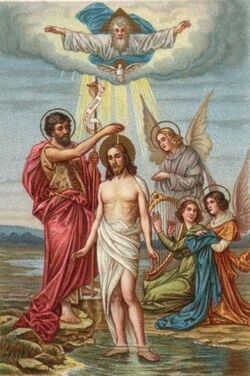
St. John the Baptist, by the inspiration of God, left the desert which he had inhabited for thirty years, and betook himself to the banks of the river Jordan. John, who in all that time had seldom spoken to any one, boldly began to preach penance, inviting the people who flocked to him to be baptized as a sign of the amendment of their lives.
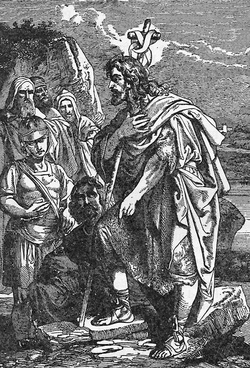
"Do penance," he cried, "for the kingdom of God is at hand." Well fitted was he to preach that penance of which he had become master. His appearance indicated the mortified man; a girdle of leather bound his body; his shoulders were covered with camels hair; he lived in no house, but under the open sky, suffering cold and heat, winds and rain. His food was locusts and wild honey, water was his drink. Such a prodigy of self-denial from his very infancy, as if he came from another world, certainly drew the attention of the religiously inclined. Even soldiers and publicans came to him attracted by his austerity, and asked what they should do. Every condition of life was represented; every sex, every age; all were there, and repeated the same question. They confessed their sins and did penance. This is what you ought to do to prepare the way of the Lord.
I know indeed, my dear children, that while you have preserved your innocence it is not necessary that I should insist very particularly on penance; but what child is there that has not known what sin is, and therefore I am right in preaching penance even to you.
But I would certainly not ask you to do any of the heroic penances such as John the Baptist practiced. For great and older sinners great penances are necessary, and they have
practiced them, as you know from history. Mary Magdalen, St. Peter, St. Paul. The great act of penance which is required even of you is to make a humble confession at the feet of the servant of God in the confessional. But even this light mark of penance does not come easy to some young people who have already fallen into sin. After having committed the sins, they hide them in their breasts; shame closes their mouths to the confessor; when asked about them they deny having committed them. To such I will say: "It is either confession or damnation." The alternative is not hard to choose, but you will find many who would rather be damned than generously declare their sins.
The priest never thinks less of the penitent who makes a clear confession. A youth once went to confession to St. Francis de Sales. He had horrible sins to tell, but he confessed them sincerely and with sorrow. When the confession was over he said to the saint with a blush: "Father, what must you think of me when you hear of such enormous sins?'' "My son,'' answered the saint, embracing him," what do I think of you? I think you are a saint. A moment ago you were a real devil, but now God has pardoned you and you are a saint."
If this was the thought of a saint about his penitent, why should you blush 'to tell all your sins in confession? But should you still feel a repugnance when you go to confession address yourself to Mary, and she will obtain for you the grace of a sincere and open confession.
There was once a girl who had committed a fault and had not the courage to confess it. For eight years she carried that unhappy ulcer of sin about her on her conscience. Though she knew it was a mortal sin, still she went to confession and communion. Outwardly she was calm, but her heart was torn by unbearable remorse. She looked happy, but she was far from being so. At last on Annunciation day she knelt before the image of our mother Mary and cried most bitterly, begging her to gain her grace to tell this fault. She obtained the grace and lived a saintly life afterwards.
There are many who confess their sins indeed, but not with sorrow; it is only by word of mouth they detest them. What did you do when you committed that wicked deed? You offended a good God who has created you, preserved and redeemed you, and for no other reason than to satisfy the demands of a vile passion and degrading habit; and by so doing you deprived yourself of God's grace, you refused Him His honor and glory, you gave yourself over to the power of Satan. Can you find a youth who will take such a view of sin? Very seldom.
This is the kind of penance which St. John wants when he says, "Do penance. Bring forth fruits worthy of penance." And thus it is that the young man who has not a real sorrow for his faults continues to live in sin, and though ostensibly repenting of his sins commits them over and over. What kind of repentance is this ? True repentance demands a real sorrow for sin, and the resolution not to commit it again. What must be foremost in the penitent's mind is the hatred of sin, the abomination of that which is so evil, however pleasing it may be to our senses. What hatred is there for a sin that is committed again?
Let us suppose that a Jew is going to become a Christian. What great consolation such an event is to all. The day approaches when he is to be baptized. He goes to the church and there is a great feast made. But soon he returns to the belief of the Synagogue. What a disappointment, what a feeling of 'disgust, yes, even of hatred, at such 'a miserable wretch! If he believed in the faith of Jesus Christ, the true one, why did he leave it? If false, why did he become a Christian? But after a while he declares he believes again in Christ and yet, for a second time, he perverts and becomes a Jew. Would you say that he was ever a real Christian? No indeed; he pretended to be one, he was always a Jew, he never had the true faith.
Let us apply this to ourselves. Can you really call him penitent who today confesses his sins and says he repents of them, but who never, even for a moment, breaks off his attachment to sin, and to-morrow willfully commits the same sins again? Does he not clearly prove that he loves his sins? This is making a mockery of God. The Lord compares such repentance to the dog that returns to its vomit. St. Paul says that such people despise the kindness of God. Will those who thus continue to sin ever have the peace of God in their souls? Oh, no! The holy peace of a pardoned sinner God gives only to the just, to His friends, not to those who return again and again to their sins. Can they expect the blessing of God at the birth of the divine Infant? No, but they may be sure that maledictions will descend upon them.
My dear children, do all you can to prepare the way of Our Lord; with the Prophet Ezechiel I say to you, "Be converted and do penance for all your iniquities; cast away from you all your transgressions by which you have transgressed, and make to yourselves a new heart and a new spirit."
With St. Augustine I call on you to prepare the way of the Lord by ornamenting your souls with the magnificent virtues of sobriety, chastity, and charity. You must make yourselves worthy to receive the loving caresses of the Child Jesus, not only by being sober in eating and drinking, but by being careful and sober in speaking, careful about the books you read. With sobriety practice purity, too. You know how highly Our Lord values that virtue, for He would have no other than an immaculate Mother and He Himself was called the immaculate Lamb. Your thoughts must be pure, also your looks, your words, your affections, and all your actions. By them show a pure and innocent heart. With all this you must not forget great love and charity, for what are all virtues without the love of God?
St. Augustine shows us in many places how we should love Our Lord. With this great doctor let us say, "I love Thee, Saviour, I desire to love Thee more. Thou art an infinite God and therefore Thou deservest to be loved with an infinite love. Sweet Infant Jesus, come to my heart, and do not delay any longer." Thus the saints loved, and the Child Jesus was so pleased with the tenderness of their love that He sometimes visited them and spoke to them words of love.
St. Gustave at the approach of Christmas felt such a love for the coming of Our Lord, that the Blessed Virgin herself came from heaven and placed the Infant Jesus in his arms on Christmas night.
St. Laurence Justinian, when he said Mass one Christmas, fell into an ecstasy at the consecration and stood there like one turned to stone. When the acolyte saw this, he went up to him and pushed him, so as to rouse him. The saint started as if wakened from a heavy slumber and said: "Why, yes, I will go on with the Mass, but what is to be done with
this beautiful child? ''
What a glorious thing would it not be to 'have such a love for Our Lord! We would then know how to prepare for the birth of the Child Jesus. We would hardly need any instructions, because love would tell us what to do. He would come and make His throne in our hearts. He would fulfill all our wishes, and give us great graces.
Source: Sermons for the Children's Masses, Imprimatur 1900
Now in the fifteenth year of the reign of Tiberius Caesar, Pontius Pilate being governor of Judea, and Herod being tetrarch of Galilee, and Philip his brother tetrareh of Iturea and the country of Trachonitis, and Lysanias tetrarch of Abilina, under the high-priests Annas and Caiphas: the word of the Lord was made unto John the son of Zachary, in the desert. And he came into all the country about Jordan, preaching the baptism of penance for the remission of sins, as it was written in the book of the sayings of Isaias the prophet: A voice of one crying in the wilderness: Prepare ye the way of the Lord, make straight his paths. Every valley shall be filled: and every mountain and hill shall be brought low: and the crooked shall be made straight, and the rough ways plain. And all flesh shall see the salvation of God.
THE BAPTISM OF PENANCE
The day is close upon us on which the Messias, the Saviour of the world, the King of the people, the Prince of Peace, the Desired of nations, is to appear on the earth. Christmas is near. You, my children, must make every effort to prepare the way for the coming of Our Saviour.
When a great king is about to visit a city, what a commotion and bustle there is! Every one makes the most magnificent preparations in his power. Our duty is not to a monarch of this world, but to the King of kings, the omnipotent God of heaven and earth. You understand, then, that it is certainly necessary to make some preparation. St. John was sent to indicate what preparation is to be made, and you ought to think of his directions and follow them.
St. John the Baptist, by the inspiration of God, left the desert which he had inhabited for thirty years, and betook himself to the banks of the river Jordan. John, who in all that time had seldom spoken to any one, boldly began to preach penance, inviting the people who flocked to him to be baptized as a sign of the amendment of their lives.
"Do penance," he cried, "for the kingdom of God is at hand." Well fitted was he to preach that penance of which he had become master. His appearance indicated the mortified man; a girdle of leather bound his body; his shoulders were covered with camels hair; he lived in no house, but under the open sky, suffering cold and heat, winds and rain. His food was locusts and wild honey, water was his drink. Such a prodigy of self-denial from his very infancy, as if he came from another world, certainly drew the attention of the religiously inclined. Even soldiers and publicans came to him attracted by his austerity, and asked what they should do. Every condition of life was represented; every sex, every age; all were there, and repeated the same question. They confessed their sins and did penance. This is what you ought to do to prepare the way of the Lord.
I know indeed, my dear children, that while you have preserved your innocence it is not necessary that I should insist very particularly on penance; but what child is there that has not known what sin is, and therefore I am right in preaching penance even to you.
But I would certainly not ask you to do any of the heroic penances such as John the Baptist practiced. For great and older sinners great penances are necessary, and they have
practiced them, as you know from history. Mary Magdalen, St. Peter, St. Paul. The great act of penance which is required even of you is to make a humble confession at the feet of the servant of God in the confessional. But even this light mark of penance does not come easy to some young people who have already fallen into sin. After having committed the sins, they hide them in their breasts; shame closes their mouths to the confessor; when asked about them they deny having committed them. To such I will say: "It is either confession or damnation." The alternative is not hard to choose, but you will find many who would rather be damned than generously declare their sins.
The priest never thinks less of the penitent who makes a clear confession. A youth once went to confession to St. Francis de Sales. He had horrible sins to tell, but he confessed them sincerely and with sorrow. When the confession was over he said to the saint with a blush: "Father, what must you think of me when you hear of such enormous sins?'' "My son,'' answered the saint, embracing him," what do I think of you? I think you are a saint. A moment ago you were a real devil, but now God has pardoned you and you are a saint."
If this was the thought of a saint about his penitent, why should you blush 'to tell all your sins in confession? But should you still feel a repugnance when you go to confession address yourself to Mary, and she will obtain for you the grace of a sincere and open confession.
There was once a girl who had committed a fault and had not the courage to confess it. For eight years she carried that unhappy ulcer of sin about her on her conscience. Though she knew it was a mortal sin, still she went to confession and communion. Outwardly she was calm, but her heart was torn by unbearable remorse. She looked happy, but she was far from being so. At last on Annunciation day she knelt before the image of our mother Mary and cried most bitterly, begging her to gain her grace to tell this fault. She obtained the grace and lived a saintly life afterwards.
There are many who confess their sins indeed, but not with sorrow; it is only by word of mouth they detest them. What did you do when you committed that wicked deed? You offended a good God who has created you, preserved and redeemed you, and for no other reason than to satisfy the demands of a vile passion and degrading habit; and by so doing you deprived yourself of God's grace, you refused Him His honor and glory, you gave yourself over to the power of Satan. Can you find a youth who will take such a view of sin? Very seldom.
This is the kind of penance which St. John wants when he says, "Do penance. Bring forth fruits worthy of penance." And thus it is that the young man who has not a real sorrow for his faults continues to live in sin, and though ostensibly repenting of his sins commits them over and over. What kind of repentance is this ? True repentance demands a real sorrow for sin, and the resolution not to commit it again. What must be foremost in the penitent's mind is the hatred of sin, the abomination of that which is so evil, however pleasing it may be to our senses. What hatred is there for a sin that is committed again?
Let us suppose that a Jew is going to become a Christian. What great consolation such an event is to all. The day approaches when he is to be baptized. He goes to the church and there is a great feast made. But soon he returns to the belief of the Synagogue. What a disappointment, what a feeling of 'disgust, yes, even of hatred, at such 'a miserable wretch! If he believed in the faith of Jesus Christ, the true one, why did he leave it? If false, why did he become a Christian? But after a while he declares he believes again in Christ and yet, for a second time, he perverts and becomes a Jew. Would you say that he was ever a real Christian? No indeed; he pretended to be one, he was always a Jew, he never had the true faith.
Let us apply this to ourselves. Can you really call him penitent who today confesses his sins and says he repents of them, but who never, even for a moment, breaks off his attachment to sin, and to-morrow willfully commits the same sins again? Does he not clearly prove that he loves his sins? This is making a mockery of God. The Lord compares such repentance to the dog that returns to its vomit. St. Paul says that such people despise the kindness of God. Will those who thus continue to sin ever have the peace of God in their souls? Oh, no! The holy peace of a pardoned sinner God gives only to the just, to His friends, not to those who return again and again to their sins. Can they expect the blessing of God at the birth of the divine Infant? No, but they may be sure that maledictions will descend upon them.
My dear children, do all you can to prepare the way of Our Lord; with the Prophet Ezechiel I say to you, "Be converted and do penance for all your iniquities; cast away from you all your transgressions by which you have transgressed, and make to yourselves a new heart and a new spirit."
With St. Augustine I call on you to prepare the way of the Lord by ornamenting your souls with the magnificent virtues of sobriety, chastity, and charity. You must make yourselves worthy to receive the loving caresses of the Child Jesus, not only by being sober in eating and drinking, but by being careful and sober in speaking, careful about the books you read. With sobriety practice purity, too. You know how highly Our Lord values that virtue, for He would have no other than an immaculate Mother and He Himself was called the immaculate Lamb. Your thoughts must be pure, also your looks, your words, your affections, and all your actions. By them show a pure and innocent heart. With all this you must not forget great love and charity, for what are all virtues without the love of God?
St. Augustine shows us in many places how we should love Our Lord. With this great doctor let us say, "I love Thee, Saviour, I desire to love Thee more. Thou art an infinite God and therefore Thou deservest to be loved with an infinite love. Sweet Infant Jesus, come to my heart, and do not delay any longer." Thus the saints loved, and the Child Jesus was so pleased with the tenderness of their love that He sometimes visited them and spoke to them words of love.
St. Gustave at the approach of Christmas felt such a love for the coming of Our Lord, that the Blessed Virgin herself came from heaven and placed the Infant Jesus in his arms on Christmas night.
St. Laurence Justinian, when he said Mass one Christmas, fell into an ecstasy at the consecration and stood there like one turned to stone. When the acolyte saw this, he went up to him and pushed him, so as to rouse him. The saint started as if wakened from a heavy slumber and said: "Why, yes, I will go on with the Mass, but what is to be done with
this beautiful child? ''
What a glorious thing would it not be to 'have such a love for Our Lord! We would then know how to prepare for the birth of the Child Jesus. We would hardly need any instructions, because love would tell us what to do. He would come and make His throne in our hearts. He would fulfill all our wishes, and give us great graces.
Source: Sermons for the Children's Masses, Imprimatur 1900

 RSS Feed